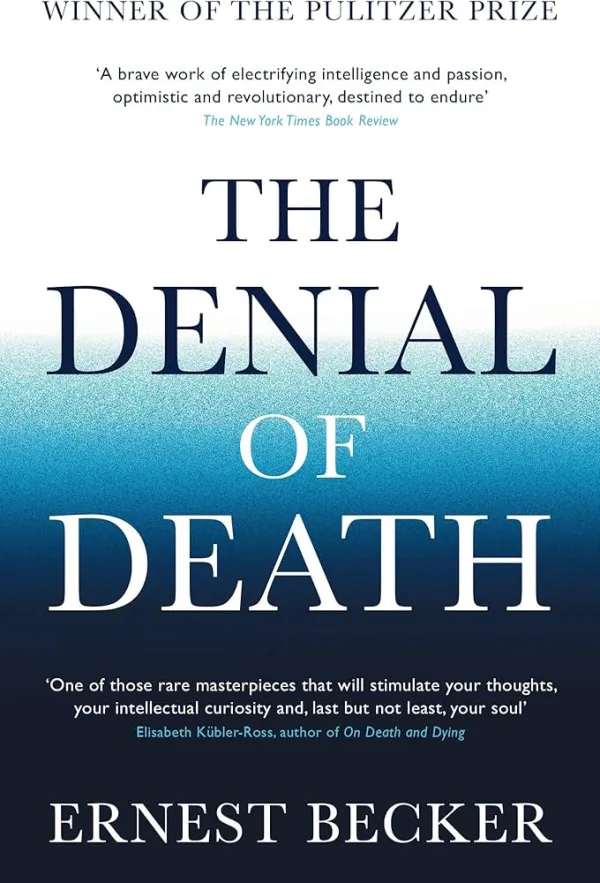
The Denial of Death
Date read: 2026-01-20
ISBN: 9781788164269
Link to buy the bookEverything we do is in denial of death. Primer on post-Freudian thought.
My notes
Society provides the second line of defense against our natural impotence by creating a hero system that allows us to believe that we transcend death by participating in something of lasting worth.
ideological conflicts between cultures are essentially battles between immortality projects, holy wars
Making a killing in business or on the battlefield frequently has less to do with economic need or political reality than with the need for assuring ourselves that we have achieved something of lasting worth.
The root of humanly caused evil is not man’s animal nature, not territorial aggression, or innate selfishness, but our need to gain self-esteem, deny our mortality, and achieve a heroic self-image.
warfare is a social ritual for purification of the world in which the enemy is assigned the role of being dirty, dangerous, and atheistic
At what cost do we purchase the assurance that we are heroic?
our need to deny our nakedness and be arrayed in glory keeps us from acknowledging that the emperor has no clothes
The science of man has shown us that society will always be composed of passive subjects, powerful leaders, and enemies upon whom we project our guilt and self-hatred. This knowledge may allow us to develop an “objective hatred” in which the hate object is not a human scapegoat but something impersonal like poverty, disease, oppression, or natural disasters.
Cultivating awareness of our death leads to disillusionment, loss of character armor, and a conscious choice to abide in the face of terror.
The disillusioned hero rejects the standardized heroics of mass culture in favor of cosmic heroism in which there is real joy in throwing off the chains of uncritical, self-defeating dependency and discovering new possibilities of choice and action and new forms of courage and endurance.
Our task for the future is exploring what it means for each individual to be a member of earth’s household, a commonwealth of kindred beings.
So long as human beings possess a measure of freedom, all hopes for the future must be stated in the subjunctive—we may, we might, we could.
The man of knowledge in our time is bowed down under a burden he never imagined he would ever have: the overproduction of truth that cannot be consumed.
One of the reasons, I believe, that knowledge is in a state of useless overproduction is that it is strewn all over the place, spoken in a thousand competitive voices.
I have had the growing realization over the past few years that the problem of man’s knowledge is not to oppose and to demolish opposing views, but to include them in a larger theoretical structure.
usually, in order to turn out a piece of work the author has to exaggerate the emphasis of it, to oppose it in a forcefully competitive way to other versions of truth;
“mankind’s common instinct for reality… has always held the world to be essentially a theatre for heroism.”
luck is when the guy next to you gets hit with the arrow.
It is one of the meaner aspects of narcissism that we feel that practically everyone is expendable except ourselves.
This narcissism is what keeps men marching into point-blank fire in wars: at heart one doesn’t feel that he will die, he only feels sorry for the man next to him.
We have learned, mostly from Alfred Adler, that what man needs most is to feel secure in his self-esteem.
Sibling rivalry is a critical problem that reflects the basic human condition: it is not that children are vicious, selfish, or domineering. It is that they so openly express man’s tragic destiny: he must desperately justify himself as an object of primary value in the universe;
When we appreciate how natural it is for man to strive to be a hero, how deeply it goes in his evolutionary and organismic constitution, how openly he shows it as a child, then it is all the more curious how ignorant most of us are, consciously, of what we really want and need.
We disguise our struggle by piling up figures in a bank book to reflect privately our sense of heroic worth. Or by having only a little better home in the neighborhood, a bigger car, brighter children.
The fact is that this is what society is and always has been: a symbolic action system, a structure of statuses and roles, customs and rules for behavior, designed to serve as a vehicle for earthly heroism.
“civilized” society is a hopeful belief and protest that science, money and goods make man count for more than any other animal.
The minority groups in present-day industrial society who shout for freedom and human dignity are really clumsily asking that they be given a sense of primary heroism of which they have been cheated historically.
to become conscious of what one is doing to earn his feeling of heroism is the main self-analytic problem of life.
human heroics is a blind drivenness that burns people up; in passionate people, a screaming for glory as uncritical and reflexive as the howling of a dog
The great perplexity of our time, the churning of our age, is that the youth have sensed—for better or for worse—a great social-historical truth: that just as there are useless self-sacrifices in unjust wars, so too is there an ignoble heroics of whole societies: it can be the viciously destructive heroics of Hitler’s Germany or the plain debasing and silly heroics of the acquisition and display of consumer goods, the piling up of money and privileges that now characterizes whole ways of life, capitalist and Soviet.
the problem of heroics is the central one of human life, that it goes deeper into human nature than anything else because it is based on organismic narcissism and on the child’s need for self-esteem as the condition for his life
I drink not from mere joy in wine nor to scoff at faith—no, only to forget myself for a moment, that only do I want of intoxication, that alone.\
—OMAR KHAYYAM
of all things that move man, one of the principal ones is his terror of death
heroism is first and foremost a reflex of the terror of death. We admire most the courage to face death; we give such valor our highest and most constant adoration; it moves us deeply in our hearts because we have doubts about how brave we ourselves would be
Man has elevated animal courage into a cult.
All historical religions addressed themselves to this same problem of how to bear the end of life
The psychiatrist Rhein-gold says categorically that annihilation anxiety is not part of the child’s natural experience but is engendered in him by bad experiences with a depriving mother.
fear of death is something that society creates and at the same time uses against the person to keep him in submission;
Gardner Murphy seems to lean to this school and urges us to study the person who exhibits the fear of death, who places anxiety in the center of his thought; and Murphy asks why the living of life in love and joy cannot also be regarded as real and basic
For behind the sense of insecurity in the face of danger, behind the sense of discouragement and depression, there always lurks the basic fear of death, a fear which undergoes most complex elaborations and manifests itself in many indirect ways….
the fear of death must be present behind all our normal functioning, in order for the organism to be armed toward self-preservation.
the fear of death cannot be present constantly in one’s mental functioning, else the organism could not function
the emergence of man as we know him: a hyperanxious animal who constantly invents reasons for anxiety even where there are none.
The forces of nature are confused, externally and internally; and for a weak ego this fact makes for quantities of exaggerated potential power and added terror. The result is that the child—at least some of the time—lives with an inner sense of chaos that other animals are immune to.
The child who is well nourished and loved develops, as we said, a sense of magical omnipotence, a sense of his own indestructibility, a feeling of proven power and secure support.
If he has been well cared for, identification comes easily and solidly, and his parents’ powerful triumph over death automatically becomes his. What is more natural to banish one’s fears than to live on delegated powers?
people have psychotic breaks when repression no longer works, when the forward momentum of activity is no longer possible
The peasant’s equanimity is usually immersed in a style of life that has elements of real madness, and so it protects him: an undercurrent of constant hate and bitterness expressed in feuding, bullying, bickering and family quarrels, the petty mentality, the self-deprecation, the superstition, the obsessive control of daily life by a strict authoritarianism, and so on.
Whichever image we choose to identify with depends in large part upon ourselves.
He is a creator with a mind that soars out to speculate about atoms and infinity, who can place himself imaginatively at a point in space and contemplate bemusedly his own planet. This immense expansion, this dexterity, this ethereality, this self-consciousness gives to man literally the status of a small god in nature, as the Renaissance thinkers knew.
Yet, at the same time, as the Eastern sages also knew, man is a worm and food for worms. This is the paradox: he is out of nature and hopelessly in it;
“Men are so necessarily mad that not to be mad would amount to another form of madness.”
He literally drives himself into a blind obliviousness with social games, psychological tricks, personal preoccupations so far removed from the reality of his situation that they are forms of madness—
“Character-traits,” said Sandor Ferenczi, one of the most brilliant minds of Freud’s intimate circle of early psychoanalysts, “are secret psychoses.”
The child is overwhelmed by experiences of the dualism of the self and the body from both areas, since he can be master of neither.
Often the child deliberately soils himself or continues to wet the bed, to protest against the imposition of artificial symbolic rules: he seems to be saying that the body is his primary reality and that he wants to remain in the simpler physical Eden and not be thrown out into the world of “right and wrong.”
To grow up at all is to conceal the mass of internal scar tissue that throbs in our dreams.
The anus and its incomprehensible, repulsive product represents not only physical determinism and boundness, but the fate as well of all that is physical: decay and death.
Or take the widespread practice of segregating women in special huts during menstruation and all the various taboos surrounding menstruation: it is obvious that man seeks to control the mysterious processes of nature as they manifest themselves within his own body.
in Swift’s mind there was an absolute contradiction “between the state of being in love and an awareness of the excremental function of the beloved.”
Excreting is the curse that threatens madness because it shows man his abject finitude, his physicalness, the likely unreality of his hopes and dreams.
The Oedipal project is the flight from passivity, from obliteration, from contingency: the child wants to conquer death by becoming the father of himself, the creator and sustainer of his own life.
The profound meaning of this is that there is no “perfect” way to bring up a child, since he “brings himself up” by trying to shape himself into an absolute controller of his own destiny
“Character is from the point of view of the psychoanalyst a sort of abnormality, a kind of mechanization of a particular way of reaction, rather similar to an obsessional symptom.”
For this reason sexuality is as much a problem for the adult as for the child: the physical solution to the problem of who we are and why we have emerged on this planet is no help—in fact, it is a terrible threat.
Love is one great key to this kind of sexuality because it allows the collapse of the individual into the animal dimension without fear and guilt, but instead with trust and assurance that his distinctive inner freedom will not be negated by an animal surrender.
If the adult reduces the problem of life to the area of sexuality, he repeats the fetishization of the child who focusses the problem of the mother upon her genitals
Sex is also a positive way of working on one’s personal freedom project. After all, it is one of the few areas of real privacy that a person has in an existence that is almost wholly social, entirely shaped by the parents and society.
If there is going to be a victory over human incompleteness and limitation, it has to be a social project and not an individual one. Society wants to be the one to decide how people are to transcend death
For life is at the start a chaos in which one is lost. The individual suspects this, but he is frightened at finding himself face to face with this terrible reality, and tries to cover it over with a curtain of fantasy, where everything is clear.
The Jonah Syndrome, then, seen from this basic point of view, is “partly a justified fear of being torn apart, of losing control, of being shattered and disintegrated, even of being killed by the experience.” And the result of this syndrome is what we would expect a weak organism to do: to cut back the full intensity of life:
The great boon of repression is that it makes it possible to live decisively in an overwhelmingly miraculous and incomprehensible world, a world so full of beauty, majesty, and terror that if animals perceived it all they would be paralyzed to act.
Animals are not moved by what they cannot react to. They live in a tiny world, a sliver of reality, one neuro-chemical program that keeps them walking behind their nose and shuts out everything else.
He not only lives in this moment, but expands his inner self to yesterday, his curiosity to centuries ago, his fears to five billion years from now when the sun will cool, his hopes to an eternity from now.
“It is precisely the godlike in ourselves that we are ambivalent about, fascinated by and fearful of, motivated to and defensive against. This is one aspect of the basic human predicament, that we are simultaneously worms and gods.”
Man had to invent and create out of himself the limitations of perception and the equanimity to live on this planet.
Freud’s greatest discovery, the one which lies at the root of psychodynamics, is that the great cause of much psychological illness is the fear of knowledge of oneself—of one’s emotions, impulses, memories, capacities, potentialities, of one’s destiny. We have discovered that fear of knowledge of oneself is very often isomorphic with, and parallel with, fear of the outside world.
We tend to be afraid of any knowledge that could cause us to despise ourselves or to make us feel inferior, weak, worthless, evil, shameful. We protect ourselves and our ideal image of ourselves by repression and similar defenses, which are essentially techniques by which we avoid becoming conscious of unpleasant or dangerous truths.
Man is reluctant to move out into the overwhelmingness of his world, the real dangers of it; he shrinks back from losing himself in the all-consuming appetites of others, from spinning out of control in the clutchings and clawings of men, beasts and machines
Each thing, in order to deliciously expand, is forever gobbling up others.
The child’s character, his style of life, is his way of using the power of others, the support of the things and the ideas of his culture, to banish from his awareness the actual fact of his natural impotence.
He is driven toward things that support the lie of his character, his automatic equanimity. But he is also drawn precisely toward those things that make him anxious, as a way of skirting them masterfully, testing himself against them, controlling them by defying them.
We enter symbiotic relationships in order to get the security we need, in order to get relief from our anxieties, our aloneness and helplessness; but these relationships also bind us, they enslave us even further because they support the lie we have fashioned. So we strain against them in order to be more free.
Even in our passions we are nursery children playing with toys that represent the real world. Even when these toys crash and cost us our lives or our sanity, we are cheated of the consolation that we were in the real world instead of the playpen of our fantasies.
It is fateful and ironic how the lie we need in order to live dooms us to a life that is never really ours.
Freud summed it up beautifully when he somewhere remarked that psychoanalysis cured the neurotic misery in order to introduce the patient to the common misery of life.
The first two layers are the everyday layers, the tactics that the child learns to get along in society by the facile use of words to win ready approval and to placate others and move them along with him: these are the glib, empty talk, “cliché,” and role-playing layers.
The third layer is a stiff one to penetrate: it is the “impasse” that covers our feeling of being empty and lost, the very feeling that we try to banish in building up our character defenses.
Underneath this layer is the fourth and most baffling one: the “death” or fear-of-death layer; and this, as we have seen, is the layer of our true and basic animal anxieties, the terror that we carry around in our secret heart.
the worst is not the death, but the rebirth itself—there’s the rub. What does it mean “to be born again” for man? It means for the first time to be subjected to the terrifying paradox of the human condition, since one must be born not as a god, but as a man, or as a god-worm, or a god who shits.
every authentic rebirth is a real ejection from paradise
the neurotic who has had therapy is like a member of Alcoholics Anonymous: he can never take his cure for granted, and the best sign of the genuineness of that cure is that he lives with humility
Full humanness means full fear and trembling, at least some of the waking day.
When you get a person to look at the sun as it bakes down on the daily carnage taking place on earth, the ridiculous accidents, the utter fragility of life, the powerlessness of those he thought most powerful—what comfort can you give him from a psychotherapeutic point of view?
He wants to be a god with only the equipment of an animal, and so he thrives on fantasies.
It achieves the very result that the child has painfully built his character over the years in order to avoid: it makes routine, automatic, secure, self-confident activity impossible.
It places a trembling animal at the mercy of the entire cosmos and the problem of the meaning of it.
He sought to express himself spontaneously, feel the most satisfaction in his bodily processes, derive the most comfort, thrill, and pleasure from others. But as this kind of limitless expansion is not possible in the world, the child has to be checked for his own good; and the parents were the checkers of his activity.
his “attitudes” came to him from his need to adapt to the whole desperate human condition, not merely to attune himself to the whims of his parents.
every human being is… equally unfree, that is, we… create out of freedom, a prison….
Rank understood that in the face of the overwhelmingness of the world the child could not out of himself muster the stamina and the authority necessary to live in full expansiveness with limitless horizons of perception and experience.
As the years have gone on, the author has found that the presentations have come to convey less and less of such blame, and to convey more and more of the tragedy of the patients’ lives—tragedy which is so much of a piece with the tragedy of life for all of us
The creativity of people on the schizophrenic end of the human continuum is a creativity that springs from the inability to accept the standardized cultural denials of the real nature of experience.
The fall into self-consciousness, the emergence from comfortable ignorance in nature, had one great penalty for man: it gave him dread, or anxiety.
Man’s anxiety is a function of his sheer ambiguity and of his complete powerlessness to overcome that ambiguity, to be straightforwardly an animal or an angel.
the final terror of self-consciousness is the knowledge of one’s own death, which is the peculiar sentence on man alone in the animal kingdom.
how is a person being enslaved by his characterological lie about himself?
; it is the closed personality, the one who has fenced himself around in childhood, not tested his own powers in action, not been free to discover himself and his world in a relaxed way
In an external respect it is easy to perceive when the moment has arrived that one ought to let the child walk alone;… the art is to be constantly present and yet not be present, to let the child be allowed to develop itself, while nevertheless one has constantly a survey clearly before one.
the “good” is the opening toward new possibility and choice, the ability to face into anxiety;
the closed shuts out revelation, obtrudes a veil between the person and his own situation in the world.
the lie of character is built up because the child needs to adjust to the world, to the parents, and to his own existential dilemmas. It is built up before the child has a chance to learn about himself in an open or free way, and thus character defenses are automatic and unconscious
the child becomes dependent on them and comes to be encased in his own character armor, unable to see freely beyond his own prison or into himself, into the defenses he is using, the things that are determining his unfreedom
They are “inauthentic” in that they do not belong to themselves, are not “their own” person, do not act from their own center, do not see reality on its terms; they are the one-dimensional men totally immersed in the fictional games being played in their society, unable to transcend their social conditioning:
For the immediate man does not recognize his self, he recognizes himself only by his dress,… he recognizes that he has a self only by externals.
freedom is dangerous. If you follow it too willingly it threatens to pull you into the air; if you give it up too wholly, you become a prisoner of necessity. The safest thing is to toe the mark of what is socially possible.
For the self is a synthesis in which the finite is the limiting factor, and the infinite is the expanding factor. Infinitude’s despair is therefore the fantastical, the limitless.
The full-blown schizophrenic is abstract, ethereal, unreal; he billows out of the earthly categories of space and time, floats out of his body, dwells in an eternal now, is not subject to death and destruction.
Instead of summoning back possibility into necessity, the man pursues the possibility—and at last cannot find his way back to himself.
Depressive psychosis is the extreme on the continuum of too much necessity, that is, too much finitude, too much limitation by the body and the behaviors of the person in the real world, and not enough freedom of the inner self, of inner symbolic possibility.
If one will compare the tendency to run wild in possibility with the efforts of a child to enunciate words, the lack of possibility is like being dumb… for without possibility a man cannot, as it were, draw breath.
One of the unconscious tactics that the depressed person resorts to, to try to make sense out of his situation, is to see himself as immensely worthless and guilty.
He holds on to the people who have enslaved him in a network of crushing obligations, belittling interaction, precisely because these people are his shelter, his strength, his protection against the world.
One chooses slavery because it is safe and meaningful; then one loses the meaning of it, but fears to move out of it. One has literally died to life but must remain physically in this world.
Breakdown occurs either because of too much possibility or too little;
philistinism is what we would call “normal neurosis.” Most men figure out how to live safely within the probabilities of a given set of social rules. The Philistine trusts that by keeping himself at a low level of personal intensity he can avoid being pulled off balance by experience;
How can the person take his private inner being, the great mystery that he feels at the heart of himself, his emotions, his yearnings and use them to live more distinctively, to enrich both himself and mankind with the peculiar quality of his talent?
The social hero-system into which we are born marks out paths for our heroism, paths to which we conform, to which we shape ourselves so that we can please others, become what they expect us to be.
Kierkegaard’s introvert feels that he is something different from the world, has something in himself that the world cannot reflect, cannot in its immediacy and shallowness appreciate; and so he holds himself somewhat apart from that world.
And so he lives in a kind of “incognito,” content to toy—in his periodic solitudes—with the idea of who he might really be; content to insist on a “little difference,” to pride himself on a vaguely-felt superiority.
Introversion is impotence, but an impotence already self-conscious to a degree, and it can become troublesome. It may lead to a chafing at one’s dependency on his family and his job, an ulcerous gnawing as a reaction to one’s embeddedness, a feeling of slavery in one’s safety.
And this brings us to our final type of man: the one who asserts himself out of defiance of his own weakness, who tries to be a god unto himself, the master of his fate, a self-created man. He will not be merely the pawn of others, of society; he will not be a passive sufferer and secret dreamer, nursing his own inner flame in oblivion. He will plunge into life,
We are witness to the new cult of sensuality that seems to be repeating the sexual naturalism of the ancient Roman world. It is a living for the day alone, with a defiance of tomorrow; an immersion in the body and its immediate experiences and sensations, in the intensity of touch, swelling flesh, taste and smell.
The ugly side of this Promethianism is that it, too, is thoughtless, an empty-headed immersion in the delights of technics with no thought to goals or meaning;
Carried to its demonic extreme this defiance gave us Hitler and Vietnam: a rage against our impotence, a defiance of our animal condition, our pathetic creature limitations. If we don’t have the omnipotence of gods, we at least can destroy like gods.
To be a “normal cultural man” is, for Kierkegaard, to be sick—whether one knows it or not: “there is such a thing as fictitious health.”
Mental health, in a word, is not typical, but ideal-typical. It is something far beyond man, something to be achieved, striven for, something that leads man beyond himself. The “healthy” person, the true individual, the self-realized soul, the “real” man, is the one who has transcended himself.
The enemy, for Kierkegaard as for Freud, is the Oedipus complex. The child has built up strategies and techniques for keeping his self-esteem in the face of the terror of his situation. These techniques become an armor that hold the person prisoner.
To live automatically and uncritically is to be assured of at least a minimum share of the programmed cultural heroics—what we might call “prison heroism”: the smugness of the insiders who “know.”
The prison of one’s character is painstakingly built to deny one thing and one thing alone: one’s creatureliness.
This is the terror: to have emerged from nothing, to have a name, consciousness of self, deep inner feelings, an excruciating inner yearning for life and self-expression—and with all this yet to die.
Education for man means facing up to his natural impotence and death.
the school of anxiety leads to possibility only by destroying the vital lie of character
And this is the simple truth—that to live is to feel oneself lost—he who accepts it has already begun to find himself, to be on firm ground.
if you admit that you are a creature, you accomplish one basic thing: you demolish all your unconscious power linkages or supports.
each child grounds himself in some power that transcends him. Usually it is a combination of his parents, his social group, and the symbols of his society and nation.
Once you expose the basic weakness and emptiness of the person, his helplessness, then you are forced to re-examine the whole problem of power linkages. You have to think about reforging them to a real source of creative and generative power.
that despite one’s true insignificance, weakness, death, one’s existence has meaning in some ultimate sense because it exists within an eternal and infinite scheme of things brought about and maintained to some kind of design by some creative force.
Possibility leads nowhere if it does not lead to faith. It is an intermediate stage between cultural conditioning, the lie of character, and the opening out of infinitude to which one can be related by faith
without the leap into faith the new helplessness of shedding one’s character armor holds one in sheer terror. It means that one lives unprotected by armor, exposed to his aloneness and helplessness, to constant anxiety
He is absolutely alone and trembling on the brink of oblivion—which is at the same time the brink of infinity.
as long as man is an ambiguous creature he can never banish anxiety; what he can do instead is to use anxiety as an eternal spring for growth into new dimensions of thought and trust. Faith poses a new life task, the adventure in openness to a multidimensional reality.
Consciousness of death is the primary repression, not sexuality.
sacrifice, of the other; through the death of the other, one buys oneself free from the penalty of dying, of being killed.”13
This kind of courage is not unusual in men who see themselves as historical figures; the self-image marshals the necessary dedication to the work that will give them immortality;
The causa-sui passion is an energetic fantasy that covers over the rumbling of man’s fundamental creatureliness, or what we can now more pointedly call his hopeless lack of genuine centering on his own energies to assure the victory of his life.
To yield is to admit that support has to come from outside oneself and that justification for one’s life has to come totally from some self-transcending web in which one consents to be suspended—as a child in its hammock-cradle, glaze-eyed in helpless, dependent admiration of the cooing mother.
The genius repeats the narcissistic inflation of the child; he lives the fantasy of the control of life and death, of destiny, in the “body” of his work.
the genius cannot do this because his project is unique; it cannot be filled up by the parents or the culture. It is created specifically by a renunciation of the parents
Guilt is a function of fear,
We can imagine that father-murder would be a complex symbol for him, comprising the heavy guilt of standing alone in his vulnerability, an attack on his identity as a father, on the psychoanalytic movement as his causa-sui vehicle, and thus on his immortality.
the genius can try to procreate himself spiritually through a linkage with gifted young men, to create them in his own image, and to pass the spirit of his genius on to them.
the narcissistic self-inflation that denies dependency on the female body and on one’s species-given role and the control and harboring of the power and meaning of one’s individuality.
nature seems unconcerned, even viciously antagonistic to human meanings; and we fight by trying to bring our own dependable meanings into the world.
One of the main reasons that it is so easy to march men off to war is that deep down each of them feels sorry for the man next to him who will die. Each protects himself in his fantasy until the shock that he is bleeding.
“Immortality means being loved by many anonymous people.”
“the need to be subject to someone remains; only the part of the father is transferred to teachers, superiors, impressive personalities;
people have a “longing for being hypnotized” precisely because they want to get back to the magical protection, the participation in omnipotence, the “oceanic feeling” that they enjoyed when they were loved and protected by their parents.
Natural narcissism—the feeling that the person next to you will die, but not you—is reinforced by trusting dependence on the leader’s power.
The masses look to the leaders to give them just the untruth that they need; the leader continues the illusions that triumph over the castration complex and magnifies them into a truly heroic victory.
In group behavior anything goes because the leader okays it.18 It is like being an omnipotent infant again, encouraged by the parent to indulge oneself plentifully, or like being in psychoanalytic therapy where the analyst doesn’t censure you for anything you feel or think.
He has kept alive Freud’s basic insight into narcissism as the primary characteristic of man: how it inflates one with the importance of his own life and makes for the devaluation of others’ lives; how it helps to draw sharp lines between “those who are like me or belong to me” and those who are “outsiders and aliens.”
Fromm has insisted, too, on the importance of what he calls “incestuous symbiosis”: the fear of emerging out of the family and into the world on one’s own responsibility and powers; the desire to keep oneself tucked into a larger source of power. It is these things that make for the mystique of “group,” “nation,” “blood,” “mother- or fatherland,” and the like.
the one who initiates the act takes upon himself both the risk and the guilt. The result is truly magic: each member of the group can repeat the act without guilt.
groups “use” the leader sometimes with little regard for him personally, but always with regard to fulfilling their own needs and urges
the leader is as much a creature of the group as they of him and that he loses his “individual distinctiveness” by being a leader, as they do by being followers. He has no more freedom to be himself than any other member of the group, precisely because he has to be a reflex of their assumptions in order to qualify for leadership in the first place
People use their leaders almost as an excuse. When they give in to the leader’s commands they can always reserve the feeling that these commands are alien to them, that they are the leader’s responsibility, that the terrible acts they are committing are in his name and not theirs.
Leaders need followers as much as they are needed by them: the leader projects onto his followers his own inability to stand alone, his own fear of isolation. We
Jung’s view was similar: fascination with someone is basically a matter of\
… always trying to deliver us into the power of a partner who seems compounded of all the qualities we have failed to realize in ourselves.
“negative form of transference in the guise of resistance, dislike, or hate endows the other person with great importance from the start….”
transference is a form of fetishism, a form of narrow control that anchors our own problems. We take our helplessness, our guilt, our conflicts, and we fix them to a spot in the environment
unless we prefer to be made fools of by our illusions, we shall, by carefully analysing every fascination, extract from it a portion of our own personality, like a quintessence, and slowly come to recognize that we meet ourselves time and again in a thousand disguises on the path of life.”
The transference object becomes the focus of the problem of one’s freedom because one is compulsively dependent on it; it sums up all other natural dependencies and emotions.
This is a logical fate for the utterly helpless person: the more you fear death and the emptier you are, the more you people your world with omnipotent father-figures, extra-magical helpers.
Man is always hungry, as Rank so well put it, for material for his own immortalization
Every group, however small or great, has, as such, an “individual” impulse for eternalization, which manifests itself in the creation of and care for national, religious, and artistic heroes… the individual paves the way for this collective eternity impulse….
“all organisms like to ‘feel good’ about themselves.”54 They push themselves to maximize this feeling.
The person reaches out naturally for a self beyond his own self in order to know who he is at all, in order to feel that he belongs in the universe.
The whole basis of the urge to goodness is to be something that has value, that endures.
We seem to know it intuitively when we console our children after their nightmares and other frights. We tell them not to worry, that they are “good” and nothing can hurt them, and so on: goodness = safety and special immunity
Dictators, revivalists, and sadists know that people like to be lashed with accusations of their own basic unworthiness because it reflects how they truly feel about themselves.
He criticizes himself because he falls short of the heroic ideals he needs to meet in order to be a really imposing creation.
man wants the impossible: He wants to lose his isolation and keep it at the same time. He can’t stand the sense of separateness, and yet he can’t allow the complete suffocating of his vitality
Man needs to infuse his life with value so that he can pronounce it “good.” The transference-object is then a natural fetishization for man’s highest yearnings and strivings.
What is more natural, then, than to take this unspeakable mystery and dispel it straightaway by addressing our performance of heroics to another human being, knowing thus daily whether this performance is good enough to earn us eternity. If it is bad, we know that it is bad by his reactions and so are able instantly to change it.
personality is shaped and formed according to the vital need to please the other person whom we make our “God,” and not incur his or her displeasure.
Transference heroics gives man precisely what he needs: a certain degree of sharply defined individuality, a definite point of reference for his practice of goodness, and all within a certain secure level of safety and control.
all the strivings for perfection, the twistings and turnings to please the other, are not necessarily cowardly or unnatural. What makes transference heroics demeaning is that the process is unconscious and reflexive, not fully in one’s control
It wants the human connection. That is the core of the whole transference phenomenon, and it is impossible to argue it away, because relationship to the self is at once relationship to our fellow man
People create the reality they need in order to discover themselves
Projection is necessary and desirable for self-fulfillment. Otherwise man is overwhelmed by his loneliness and separation and negated by the very burden of his own life
As Rank so wisely saw, projection is a necessary unburdening of the individual; man cannot live closed upon himself and for himself. He must project the meaning of his life outward, the reason for it, even the blame for it
It seems to be difficult for the individual to realize that there exists a division between one’s spiritual and purely human needs, and that the satisfaction or fulfillment for each has to be found in different spheres. As a rule, we find the two aspects hopelessly confused in modern relationships, where one person is made the godlike judge over good and bad in the other person. In the long run, such symbiotic relationship becomes demoralizing to both parties, for it is just as unbearable to be God as it is to remain an utter slave.
Culture opposes nature and transcends it. Culture is in its most intimate intent a heroic denial of creatureliness.
This is the most remarkable achievement of the Christian world picture: that it could take slaves, cripples, imbeciles, the simple and the mighty, and make them all secure heroes, simply by taking a step back from the world into another dimension of things, the dimension called heaven.
The point is that if the love object is divine perfection, then one’s own self is elevated by joining one’s destiny to it.
Modern man fulfills his urge to self-expansion in the love object just as it was once fulfilled in God: “God as… representation of our own will does not resist us except when we ourselves want it, and just as little does the lover resist us who, in yielding, subjects himself to our will
Modern man’s dependency on the love partner, then, is a result of the loss of spiritual ideologies, just as is his dependency on his parents or on his psychotherapist.
But this is just what the comfortable sex relationship is for: in sex the body and the consciousness of it are no longer separated; the body is no longer something we look at as alien to ourselves.
If sex is a fulfillment of his role as an animal in the species, it reminds him that he is nothing himself but a link in the chain of being, exchangeable with any other and completely expendable in himself.
He brought sexual taboos into being because he needed to triumph over the body, and he sacrificed the pleasures of the body to the highest pleasure of all: self-perpetuation as a spiritual being through all eternity.
Resistance to sex is a resistance to fatality.
The questions about sex that the child asks are thus not—at a fundamental level—about sex at all. They are about the meaning of the body, the terror of living with a body.
“biological solution of the problem of humanity is also ungratifying and inadequate for the adult as for the child.”
We might say that the child is still too weak to be able to bear the conflict of trying to be a personality and a species animal at the same time. The adult is, too, but he has been able to develop the necessary mechanisms of defense, repression and denial, that allow him to live with the problem of serving two masters.
The partner represents a kind of fulfillment in freedom from self-consciousness and guilt; but at the same time he represents the negation of one’s distinctive personality
If the partner becomes God he can just as easily become the Devil; the reason is not far to seek.
If you find the ideal love and try to make it the sole judge of good and bad in yourself, the measure of your strivings, you become simply the reflex of another person.
It is impossible to get blood from a stone, to get spirituality from a physical being, and so one feels “inferior” that his life has somehow not succeeded, that he has not realized his true gifts, and so on.18
The thing that makes God the perfect spiritual object is precisely that he is abstract—
When we look for the “perfect” human object we are looking for someone who allows us to express our will completely, without any frustration or false notes. We want an object that reflects a truly ideal image of ourselves.20 But no human object can do this; humans have wills and counterwills of their own, in a thousand ways they can move against us, their very appetites offend us.
If your partner is your “All” then any shortcoming in him becomes a major threat to you
The shadow of imperfection falls over our lives, and with it—death and the defeat of cosmic heroism. “She lessens” = “I die.” This is the reason for so much bitterness, shortness of temper and recrimination in our daily family lives.
Our interiors feel empty or anguished, our lives valueless, when we see the inevitable pettinesses of the world expressed through the human beings in it. For this reason, too, we often attack loved ones and try to bring them down to size.
the deflation of the over-invested partner, parent, or friend is a creative act that is necessary to correct the lie that we have been living, to reaffirm our own inner freedom of growth that transcends the particular object and is not bound to it.
We may have no other God and we may prefer to deflate ourselves in order to keep the relationship, even though we glimpse the impossibility of it and the slavishness to which it reduces us.22 This is one direct explanation—as we shall see—of the phenomenon of depression.
We turn to the love partner for the experience of the heroic, for perfect validation; we expect them to “make us good” through love.
Redemption can only come from outside the individual, from beyond, from our conceptualization of the ultimate source of things, the perfection of creation. It can only come, as Rank saw, when we lay down our individuality, give it up, admit our creatureliness and helplessness.
He cannot stand the burden of godhood, and so he must resent the slave.
how can one be a genuine god if one’s slave is so miserable and unworthy?
relationships to others and to the world. But that is not at all true. The great lesson of Rank’s depreciation of sexuality was not that he played down physical love and sensuality, but that he saw—like Augustine and Kierkegaard—that man cannot fashion an absolute from within his condition, that cosmic heroism must transcend human relationships
personal heroism through individuation is a very daring venture precisely because it separates the person out of comfortable “beyonds
The most terrifying burden of the creature is to be isolated, which is what happens in individuation: one separates himself out of the herd. This move exposes the person to the sense of being completely crushed and annihilated because he sticks out so much, has to carry so much in himself
The work of art is, then, the ideal answer of the creative type to the problem of existence as he takes it in—not only the existence of the external world, but especially his own: who he is as a painfully separate person with nothing shared to lean on
His creative work is at the same time the expression of his heroism and the justification of it. It is his “private religion”—as Rank put it.29 Its uniqueness gives him personal immortality; it is his own “beyond” and not that of others.
the more you develop as a distinctive free and critical human being, the more guilt you have. Your very work accuses you; it makes you feel inferior. What right do you have to play God
You wonder where to get authority for introducing new meanings into the world, the strength to bear it.
No matter how great it is, it still pales in some ways next to the transcending majesty of nature; and so it is ambiguous, hardly a solid immortality symbol. In his greatest genius man is still mocked. No wonder that historically art and psychosis have had such an intimate relationship, that the road to creativity passes so close to the madhouse and often detours or ends there.
if you are going to be a hero then you must give a gift. If you are the average man you give your heroic gift to the society in which you live, and you give the gift that society specifies in advance. If you are an artist you fashion a peculiarly personal gift, the justification of your own heroic identity, which means that it is always aimed at least partly over the heads of your fellow men.
To renounce the world and oneself, to lay the meaning of it to the powers of creation, is the hardest thing for man to achieve—and so it is fitting that this task should fall to the strongest personality type, the one with the largest ego.
In the creative genius we see the need to combine the most intensive Eros of self-expression with the most complete Agape of self-surrender.
One should reach for the highest beyond of religion: man should cultivate the passivity of renunciation to the highest powers no matter how diffcult it is. Anything less is less than full development, even if it seems like weakness and compromise to the best thinkers.
Man feels inferior precisely when he lacks “true inner values in the personality,” when he is merely a reflex of something next to him and has no steadying inner gyroscope, no centering in himself. And in order to get such centering man has to look beyond the “thou,” beyond the consolations of others and of the things of this world.36
Man is a “theological being,” concludes Rank, and not a biological one.
If man is the more normal, healthy and happy, the more he can… successfully… repress, displace, deny, rationalize, dramatize himself and deceive others, then it follows that the suffering of the neurotic comes… from painful truth….
Neurosis has three interdependent aspects. In the first place it refers to people who are having trouble living with the truth of existence; it is universal in this sense because everybody has some trouble living with the truth of life and pays some vital ransom to that truth. In the second place, neurosis is private because each person fashions his own peculiar stylistic reaction to life. Finally, beyond both of these is perhaps the unique gift of Rank’s work: that neurosis is also historical to a large extent, because all the traditional ideologies that disguised and absorbed it have fallen away and modern ideologies are just too thin to contain it.
repression is normal self-protection and creative self-restriction—in a real sense, man’s natural substitute for instinct
What we call the well-adjusted man has just this capacity to partialize the world for comfortable action.2 I have used the term “fetishization,” which is exactly the same idea: the “normal” man bites off what he can chew and digest of life, and no more.
Most men spare themselves this trouble by keeping their minds on the small problems of their lives just as their society maps these problems out for them.
We can say that the essence of normality is the refusal of reality.3 What we call neurosis enters precisely at this point: Some people have more trouble with their lies than others.
We call a man “neurotic” when his lie begins to show damaging effects on him or on people around him and he seeks clinical help for it—or others seek it for him. Otherwise, we call the refusal of reality “normal” because it doesn’t occasion any visible problems.
we call neurotic any life style that begins to constrict too much, that prevents free forward momentum, new choices, and growth that a person may want and need.
The object has become his “All,” his whole world; and he is reduced to the status of a simple reflex of another human being.
Guilt results from unused life, from “the unlived in us.”
When you put all your eggs in one basket you must clutch that basket for dear life. It is as though one were to take the whole world and fuse it into a single object or a single fear. We immediately recognize this as the same creative dynamic that the person uses in transference, when he fuses all the terror and majesty of creation in the transference-object.
It must be clear that the despair and anguish of which the patient complains is not the result of such symptoms but rather are the reasons for their existence. It is in fact these very symptoms that shield him from the torment of the profound contradictions that lie at the heart of human existence.
Thus, neurotic symptoms serve to reduce and narrow—to magically transform the world so that he may be distracted from his concerns of death, guilt, and meaninglessness. The neurotic preoccupied with his symptom is led to believe that his central task is one of confrontation with his particular obsession or phobia. In a sense his neurosis allows him to take control of his destiny—to transform the whole of life’s meaning into the simplified meaning emanating from his self-created world.
The ironic thing about the narrowing-down of neurosis is that the person seeks to avoid death, but he does it by killing off so much of himself and so large a spectrum of his action-world that he is actually isolating and diminishing himself and becomes as though dead.
To have difficulty partializing experience is to have difficulty living. Not to be able to fetishize makes one susceptible to the world as a total problem—with all the living hell that this exposure raises.
Now we can see how the problem of neurosis can be laid out along the lines of the twin ontological motives: on the one hand, one merges with the world around him and becomes too much a part of it and so loses his own claim to life. On the other hand, one cuts oneself off from the world in order to make one’s own complete claim and so loses the ability to live and act in the world on its terms.
Playing the game of society with automatic ease means playing with others without anxiety. If you are not involved in what others take for granted as the nourishment of their lives, then your own life becomes a total problem.
The psychotic is the one who cannot shut out the world, whose repressions are all on the surface, whose defenses no longer work; and so he withdraws from the world and into himself and his fantasies. He fences himself off and becomes his own world (narcissism).
It may seem courageous to take in the whole world, instead of just biting off pieces and acting on them, but as Rank points out, this is also precisely a defense against engagement in it:
To live is to engage in experience at least partly on the terms of the experience itself. One has to stick his neck out in the action without any guarantees about satisfaction or safety.
We can see that neurosis is par excellence the danger of a symbolic animal whose body is a problem to him. Instead of living biologically, then, he lives symbolically.
everyone is neurotic, as everyone holds back from life in some ways and lets his symbolic world-view arrange things: this is what cultural morality is for.
the artist is the most neurotic because he too takes the world as a totality and makes a largely symbolic problem out of it
The person has tried to cheat nature by restricting his experience, but he remains sensitive to the terror of life at some level of his awareness. Besides, he can’t arrange his triumph over life and death in his mind or in his narrow heroics without paying some price: the symptom or a bogging down in guilt and futility because of an unlived life.
The neurotic can’t marshal this creative response embodied in a specific work, and so he chokes on his introversions. The artist has similar large-scale introversions, but he uses them as material.
The neurotic exhausts himself not only in self-preoccupations like hypochondriacal fears and all sorts of fantasies, but also in others: those around him on whom he is dependent become his therapeutic work project; he takes out his subjective problems on them. But people are not clay to be molded; they have needs and counter-wills of their own.
The neurotic’s frustration as a failed artist can’t be remedied by anything but an objective creative work of his own.
He can’t endure himself or the isolation that his individuality plunges him into. On the other hand, he still needs to be a hero, still needs to earn immortality on the basis of his unique qualities, which means that he still must glorify himself in some ways. But he can glorify himself only in fantasy, as he cannot fashion a creative work that speaks on his behalf by virtue of its objective perfection. He is caught in a vicious circle because he experiences the unreality of fantasied self-glorification.
One simply cannot justify his own heroism in his own inner symbolic fantasy, which is what leads the neurotic to feel more unworthy and inferior. This is pretty much the situation of the adolescent who has not discovered his inner gifts. The artist, on the other hand, overcomes his inferiority and glorifies himself because he has the talent to do so.
Artists are neurotic as well as creative; the greatest of them can have crippling neurotic symptoms and can cripple those around them as well by their neurotic demands and needs.
what we call a creative gift is merely the social license to be obsessed. And what we call “cultural routine” is a similar license: the proletariat demands the obsession of work in order to keep from going crazy.
I used to wonder how people could stand the really demonic activity of working behind those hellish ranges in hotel kitchens, the frantic whirl of waiting on a dozen tables at one time, the madness of the travel agent’s office at the height of the tourist season, or the torture of working with a jack-hammer all day on a hot summer street. The answer is so simple that it eludes us: the craziness of these activities is exactly that of the human condition. They are “right” for us because the alternative is natural desperation.
What is the nature of the obsessive denials of reality that a Utopian society will provide to keep men from going mad?
We have looked at neurosis as a problem of character and have seen that it can be approached in two ways: as a problem of too much narrowness toward the world or of too much openness.
His anality may protect him, but all through history it is the “normal, average men” who, like locusts, have laid waste to the world in order to forget themselves.
But in back of the causa-sui project whispers the voice of possible truth: that human life may not be more than a meaningless interlude in a vicious drama of flesh and bones that we call evolution;
“The caricature aspect of life appears whenever the drunkenness of illusion wears off.”
To be able to live one needs illusions, not only outer illusions such as art, religion, philosophy, science and love afford, but inner illusions which first condition the outer [i.e., a secure sense of one’s active powers, and of being able to count on the powers of others].
To lose the security of heroic cultural illusion is to die—that is what “deculturation” of primitives means and what it does. It kills them or reduces them to the animal level of chronic fighting and fornication.
What characterizes modern life is the failure of all traditional immortality ideologies to absorb and quicken man’s hunger for self-perpetuation and heroism. Neurosis is today a widespread problem because of the disappearance of convincing dramas of heroic apotheosis of man.
He needs revolutions and wars and “continuing” revolutions to last when the revolutions and wars end. That is the price modern man pays for the eclipse of the sacred dimension.
All the analysis in the world doesn’t allow the person to find out who he is and why he is here on earth, why he has to die, and how he can make his life a triumph.
psychology has limited its understanding of human unhappiness to the personal life-history of the individual and has not understood how much individual unhappiness is itself a historical problem in the larger sense, a problem of the eclipse of secure communal ideologies of redemption.
Modern man needs a “thou” to whom to turn for spiritual and moral dependence, and as God was in eclipse, the therapist has had to replace Him—just as the lover and the parents did
Man is thereby deprived of the absolute mystery he needs, and the only omnipotent thing that then remains is the man who explained it away.37 And so the patient clings to the analyst with all his might and dreads terminating the analysis.†
the very furthest reaches of scientific description, psychology has to give way to “theology”—that is, to a world-view that absorbs the individual’s conflicts and guilt and offers him the possibility for some kind of heroic apotheosis
In sin and neurosis man fetishizes himself on something narrow at hand and pretends that the whole meaning and miraculousness of creation is limited to that, that he can get his beatification from that.38
Sin and neurosis have another side: not only their unreal self-inflation in the refusal to admit creatureliness but also a penalty for intensified self-consciousness: the failure to be consoled by shared illusions. The result is that the sinner (neurotic) is hyper-conscious of the very thing he tries to deny: his creatureliness, his miserableness and unworthiness.
He tried to build a glorified private inner world because of his deeper anxieties, but life takes its revenge. The more he separates and inflates himself, the more anxious he becomes. The more he artificially idealizes himself, the more exaggeratedly he criticizes himself. He alternates between the extremes of “I am everything” and “I am nothing.”
It is all right to be nothing vis-à-vis God, who alone can make it right in His unknown ways; it is another thing to be nothing to oneself, who is nothing.
The neurotic type suffers from a consciousness of sin just as much as did his religious ancestor, without believing in the conception of sin. This is precisely what makes him “neurotic”; he feels a sinner without the religious belief in sin for which he therefore needs a new rational explanation.
The myth-ritual complex is a social form for the channelling of obsessions. We might say that it places creative obsession within the reach of everyman, which is precisely the function of ritual.
all social life is the obsessive ritualization of control in one way or another. It automatically engineers safety and banishes despair by keeping people focussed on the noses in front of their faces
Beyond a given point man is not helped by more “knowing,” but only by living and doing in a partly self-forgetful way. As Goethe put it, we must plunge into experience and then reflect on the meaning of it. All reflection and no plunging drives us mad; all plunging and no reflection, and we are brutes.
Neurosis is the contriving of private obsessional ritual to replace the socially-agreed one now lost by the demise of traditional society.
In order for something to seem true to man, it has to be visibly supported in some way—lived, external, compelling. Men need pageants, crowds, panoplies, special days marked off on calendars—an objective focus for obsession, something to give form and body to internal fantasy, something external to yield oneself to. Otherwise the neurotic is brought back to the point of his departure: how is he to believe in his lonely, inner sense of specialness
Madmen are the greatest reasoners we know, and that trait is one of the accompaniments of their undoing. All their vital processes are shrunken into the mind. What is the one thing they lack that sane men possess? The ability to be careless, to disregard appearances, to relax and laugh at the world.
the only secure truth men have is that which they themselves create and dramatize; to live is to play at the meaning of life. The upshot of this whole tradition of thought is that it teaches us once and for all that childlike foolishness is the calling of mature men.
The personality can truly begin to emerge in religion because God, as an abstraction, does not oppose the individual as others do, but instead provides the individual with all the powers necessary for independent self-justification
religion solves the problem of death, which no living individuals can solve, no matter how they would support us. Religion, then, gives the possibility of heroic victory in freedom and solves the problem of human dignity at its highest level.
Religion takes one’s very creatureliness, one’s insignificance, and makes it a condition of hope. Full transcendence of the human condition means limitless possibility unimaginable to us.
mental health is a problem of ideal illusion
if you don’t fetishize the world by transference perceptions, totalities of experience put a tremendous burden on the ego and risk annihilating it. The creative person is too full both of himself and of the world.
I think if we push the analysis to its ultimate point we have to say that each earthly father accuses us of our impotence if we become truly creative personalities; they remind us that we are born of men and not gods.
The great characteristic of our time is that we know everything important about human nature that there is to know. Yet never has there been an age in which so little knowledge is securely possessed, so little a part of the common understanding.
mental illness is a way of talking about people who have lost courage, which is the same as saying that it reflects the failure of heroism.
When does the person have the most trouble with his self-esteem? Precisely when his heroic transcendence of his fate is most in doubt, when he doubts his own immortality, the abiding value of his life; when he is not convinced that his having lived really makes any cosmic difference. From this point of view we might well say that mental illness represents styles of bogging-down in the denial of creatureliness.
Adler had already revealed how perfectly depression or melancholia is a problem of courage; how it develops in people who are afraid of life, who have given up any semblance of independent development and have been totally immersed in the acts and the aid of others.
If one’s life has been a series of “silent retreats,”3 one ends up firmly wedged into a corner and has nowhere else to retreat.
one must pay with life and consent daily to die, to give oneself up to the risks and dangers of the world, allow oneself to be engulfed and used up. Otherwise one ends up as though dead in trying to avoid life and death
we ourselves had so effectively banished the idea of the fear of death and life; we were not sufficiently impressed by the terror of the living creature; and so we could not understand the torturings and turnings of anguished people who were jerked about by these terrors.
Transference is the positive use of the object for eternal self-perpetuation. This explains the durability of transference and its strength, even after the death of the object: “I am immortal by continuing to please this object who now may not be alive but continues to cast a shadow by what it has left behind and may even be working its powers from the invisible spirit world.”
Dependency is the basic survival mechanism of the human organism…. When the adult gives up hope in his ability to cope and sees himself incapable of either fleeing or fighting, he is “reduced” to a state of depression. This very reduction with its parallel to the helplessness of infancy becomes… a plea for a solution to the problem of survival via dependency. The very stripping of one’s defenses becomes a form of defensive maneuver.
“they were not in the world to please their partner, nor he to please them.”
Better guilt and self-punishment when you cannot punish the other—when you cannot even dare to accuse him, as he represents the immortality ideology with which you have identified.
With guilt you lose some of your life but avoid the greater evil of death.7 The depressed person exaggerates his guilt because it unblocks his dilemma in the safest and easiest way.
He controls them and heightens his own personality by his very self-pity and self-hatred.
A constant danger in science is that each gain risks abandoning ground that was once securely annexed.
The woman is reminded in the most forceful way that she is an animal thing; menopause is a sort of “animal birthday” that specifically marks the physical career of degeneration.
psychoanalysis has to be broadened to take in the fear of death rather than fears of punishment from the parents. It is not the parents who are the “castrators” but nature herself
menopausal depression is peculiarly a phenomenon of those societies in which aging women are deprived of some continuing useful place, some vehicle for heroism that transcends the body and death
instead of the eternity of life that one has a right to take for granted under the umbrella of a secure schema of self-perpetuation, the depressed person feels instead condemned to an eternity of destruction
He is the “realist” that William James talked about when he said that the right reaction to the horrors of organismic life on this planet is the psychotic one.
We might even say that the psychotic uses blatantly, openly, and in an exaggerated way the same kinds of thought-defenses that most people use wishfully, hiddenly, and in a more controlled way, just as the melancholic uses blatantly the defenses of the milder, more “normal” depressions of the rest of us: an occasional giving in to despair, a secret hatred of our loved ones, a quiet self-accusation and sorrowful guilt. In this sense the psychoses are a caricature of the life styles of all of us—which is probably part of the reason that they make us so uncomfortable.
Schizophrenia takes the risk of evolution to its furthest point in man: the risk of creating an animal who perceives himself, reflects on himself, and comes to understand that his animal body is a menace to himself.
Freud very aptly called the syndrome “narcissistic neurosis”: the ballooning of the self in fantasy, the complete megalomanic self-inflation as a last defense, as an attempt at utter symbolic power in the absence of lived physical power. Again, this is what cultural man everywhere strove to achieve, but the “normal” person is neurally programmed so that he feels at least that his body is his to use with confidence.
By pushing the problem of man to its limits, schizophrenia also reveals the nature of creativity. If you are physically unprogrammed in the cultural causa-sui project, then you have to invent your own: you don’t vibrate to anyone else’s tune. You see that the fabrications of those around you are a lie, a denial of truth—a truth that usually takes the form of showing the terror of the human condition more fully than most men experience it. The creative person becomes, then, in art, literature, and religion the mediator of natural terror and the indicator of a new way to triumph over it
The schizophrenic is not programmed neurally into automatic response to social meanings, but he cannot marshal an ego response, a directive control of his experiences. His own erupting meanings cannot be given any creative form. We might say that because of his exaggerated helplessness he uses his symbolic inner experiences alone as an experiential anchor, as something to lean on. He exists reflexively toward them, comes to be controlled by them instead of reshaping and using them. The genius too is not programmed in automatic cultural meanings; but he has the resources of a strong ego, or at least a sufficient one, to give his own personal meanings a creative form.
The only way for a lonely cripple to attempt a heroic transcendence of death is through the complete servitude of personal idolatry, the total constriction of the self in the person of the other.
The wish for the phallic mother, the horror of the female genitals, may well be a universal experience of mankind, for girls as well as boys. But the reason is that the child wants to see the omnipotent mother, the miraculous source of all his protection, nourishment, and love, as a really godlike creature complete beyond the accident of a split into two sexes. The threat of the castrated mother is thus a threat to his whole existence in that his mother is an animal thing and not a transcendent angel.
children really toilet train themselves because of the existential anxiety of the body. It is often pathetic how broken up they get when they accidentally wet their pants, or how quickly and easily they give in to public morality and will not urinate or defecate any more in the street “where someone might see.” They do this quite on their own, even after being raised by the most unashamed parents. It is obvious that they are shamed by their own bodies. We can conclude quite categorically that hypochondrias and phobias are focalizations of the terror of life and death by an animal who doesn’t want to be one.
perversion is a protest against species sameness, against submergence of the individuality into the body. It is even a focus of personal freedom vis-à-vis the family, one’s own secret way of affirming himself against all standardization.
Rank even makes the breathtaking speculation that the Oedipus complex in the classic Freudian understanding may be an attempt by the child to resist the family organization, the dutiful role of son or daughter, the absorption into the collective, by affirming his own ego.
The distinctive human problem from time immemorial has been the need to spiritualize human life, to lift it onto a special immortal plane, beyond the cycles of life and death that characterize all other organisms.
As we saw above, the childhood experience is crucial in developing a secure sense of one’s body, firm identification with the father, strong ego control over oneself, and dependable interpersonal skills. Only if one achieves these can he “do the species role” in a self-forgetful way, a way that does not threaten to submerge him with annihilation anxiety.
The lover gives himself in joy and self-forgetful fulfillment, the body becomes the treasured vehicle for one’s apotheosis, and one experiences real gratitude precisely to the species sameness. One is glad to have a standardized body because it permits the love union.
Finally, in schizoid persons, the anxiety connected with the species body is so great that they can simply dissociate themselves from their bodies, even during the act of sexual intercourse. In this way they preserve the sanctity of their own inner selves against the degradations of the body.
The fetish object represents the magical means for transforming animality into something transcendent and thereby assuring a liberation of the personality from the standardized, bland, and earthbound flesh.
the person hypnotizes himself with the fetish and creates his own aura of fascination that completely transforms the threatening reality.57 In other words, men use the fabrications of culture, in whatever form, as charms with which to transcend natural reality.
No wonder fetishism is universal, as Freud himself remarked: all cultural contrivances are self-hypnotic devices—from motorcars to moon rockets—ways that a sorely limited animal can drum up to fascinate himself with the powers of transcendence over natural reality.
The foot is the absolute and unmitigated testimonial to our degraded animality, to the incongruity between our proud, rich, lively, infinitely transcendent, free inner spirit and our earth-bound body.
The secret implies, above all, power to control the given by the hidden and thus power to transcend the given—nature, fate, animal destiny.
Secret magic and private dramatization may be a hold on reality, the creation of a personal world, but they also separate the practitioner from reality, just as cultural contrivances do on a more standardized level.
The biggest, warmest, most secure, courageous spirits can still only bite off pieces of the world; the smallest, meanest, most frightened ones merely bite off the smallest possible pieces.
I recall the episode of the illustrious Immanuel Kant when a glass was broken at one of his gatherings; how carefully he weighed the alternatives for a perfect place in the garden where the fragments could safely be buried so that no one would be injured by them accidentally. Even our greatest spirits must indulge in the fetishist’s magical, ritual drama to banish accident because of animal vulnerability.
Masochism comes naturally to man, as we have seen again and again in these pages. Man is naturally humble, naturally grateful, naturally guilty, naturally transcended, naturally a sufferer; he is small, pitiful, weak, a passive taker who tucks himself naturally in a beyond of superior, awesome, all-embracing power.
Sadism likewise is the natural activity of the creature, the drive toward experience, mastery, pleasure, the need to take from the world what it needs in order to increase itself and thrive;77 what is more, a human creature who has to forget himself, resolve his own painful inner contradictions.
As Irving Bieber argued in his important paper, the masochist doesn’t “want” pain, he wants to be able to identify its source, localize it, and so control it. Masochism is thus a way of taking the anxiety of life and death and the overwhelming terror of existence and congealing them into a small dosage.
As Zilboorg so penetratingly observed, the sado-masochistic combination is the perfect formula for transmuting the fear of death.80 Rank called masochism the “small sacrifice,” the “lighter punishment,” the “placation” that allows one to avoid the arch-evil of death.
As Henry Hart also observed so well, this is a way of taking self-administered, homeopathic doses; the ego controls total pain, total defeat, and total humiliation by experiencing them in small doses as a sort of vaccination
The sado-masochist is someone who plays out his drama of heroism vis-à-vis one person only; he is exercising his two ontological motives—Eros and Agape—on the love object alone.
From this vantage point the theory of mental illness is really a general theory of the failures of death-transcendence. The avoidance of life and the terror of death become enmeshed in the personality to such an extent that it is crippled—unable to exercise the “normal cultural heroism” of other members of the society. The result is that the person cannot permit himself the routine heroic self-expansion nor the easy yielding to the superordinate cultural world-view that other members can. This is why he becomes a burden on others in some way.
the depressed person is one who has embedded himself so comfortably in the powers and protection of others that he has forfeited his own life.
What links all the perversions is the inability to be a responsible human animal. Erich Fromm had already well described masochism as an attempt to get rid of the burden of freedom
The suffering and the evil that stems from these motives are not a consequence of the nature of the motives themselves, but of our stupidity about satisfying them.
To leave behind stupidity is to become aware of life as a problem of heroics, which inevitably becomes a reflection about what life ought to be in its ideal dimensions.
the perversions of “private religions” are not “false” in comparison to “true religions.” They are simply less expansive, less humanly noble and responsible
Today we know that people try so hard to win converts for their point of view because it is more than merely an outlook on life: it is an immortality formula.
In Rank’s system of thought the most generous judgment that might probably be made about Freud’s limitations was that he shared the human weakness of the neurotic: he lacked the capacity for illusion, for a creative myth about the possibilities of creation. He saw things too “realistically,” without their aura of miracle and infinite possibility. The only illusion he allowed himself was that of his own science—and such a source is bound to be a shaky support because it comes from one’s own energies and not from a powerful beyond.
My point is that for man not everything is possible. What is there to choose between religious creatureliness and scientific creatureliness? The most one can achieve is a certain relaxedness, an openness to experience that makes him less of a driven burden on others.
in this world each organism lives to be consumed by its own energies; and those that are consumed with the most relentlessness, and burn with the brightest flame, seem to serve the purposes of nature best, so far as accomplishing anything on this planet is concerned
guilt is not a result of infantile fantasy but of self-conscious adult reality. There is no strength that can overcome guilt unless it be the strength of a god; and there is no way to overcome creature anxiety unless one is a god and not a creature.
To talk about a “new man” whose ego merges wholly with his body is to talk about a subhuman creature, not a superhuman one.\
The ego, in order to develop at all, must deny, must bind time, must stop the body.
repression is not falsification of the world, it is “truth”—the only truth that man can know, because he cannot experience everything.
Rieff’s point is the classical one: that in order to have a truly human existence there must be limits; and what we call culture or the superego sets such limits.
Or, as I would prefer to say with Rank, the neurotic consciousness—the “all or nothing” of the person who cannot “partialize” his world. One bursts out in boundless megalomania, transcending all limits, or bogs down into wormhood like a truly worthless sinner. There is no secure ego balance to limit the intake of reality or to fashion the output of one’s own powers.
“Character is the restrictive shaping of possibility.”
the prophets of unrepression simply have not understood human nature; they envisage a utopia with perfect freedom from inner constraint and from outer authority
Abstractions will never do. God-terms have to be exemplified…. Men crave their principles incarnate in enactable characters, actual selective mediators between themselves and the polytheism of experience.
I see this utopia in one way resembling the beliefs of many primitive societies. They denied that death was the total end of experience and believed instead that it was the final ritual promotion to a higher form of life.
Psychotherapy is such a growing vogue today because people want to know why they are unhappy in hedonism and look for the faults within themselves.
even with the highest personal development and liberation, the person comes up against the real despair of the human condition. Indeed, because of that development his eyes are opened to the reality of things; there is no turning back to the comforts of a secure and armored life
Not everyone is as honest as Freud was when he said that he cured the miseries of the neurotic only to open him up to the normal misery of life.
Commercial industrialism promised Western man a paradise on earth, described in great detail by the Hollywood Myth, that replaced the paradise in heaven of the Christian myth. And now psychology must replace them both with the myth of paradise through self-knowledge.
If psychology is to be the modern religion, then it has to reflect lived experience; it has to move away from mere talking and intellectual analysis to the actual screaming out of the “traumas of birth” and childhood, the acting-out of dreams and hostility, and so on
The fusion of psychology and religion is thus not only logical, it is necessary if the religion is to work. There is no way of standing on one’s own center without outside support, only now this support is made to seem to come from the inside. The person is conditioned to function under his own control, from his own center, from the spiritual powers that well up within him. Actually, of course, the support comes from the transference certification by the guru that what the disciple is doing is true and good.
Most of all, as William James and Tillich have argued, beliefs about reality affect people’s real actions: they help introduce the new into the world. Especially is this true for beliefs about man, about human nature, and about what man may yet become. If something influences our efforts to change the world, then to some extent it must change that world.
Fromm has nicely argued the Deweyan thesis that, as reality is partly the result of human effort, the person who prides himself on being a “hard-headed realist” and refrains from hopeful action is really abdicating the human task.
A creative myth is not simply a relapse into comfortable illusion; it has to be as bold as possible in order to be truly generative
No longer does one do as God wills, set over against some imaginary figure in heaven. Rather, in one’s own person he tries to achieve what the creative powers of emergent Being have themselves so far achieved with lower forms of life: the overcoming of that which would negate life.
Transference, even after we admit its necessary and ideal dimensions, reflects some universal betrayal of man’s own powers, which is why he is always submerged by the large structures of society.
The critique of guru therapies also comes to rest here: you can’t talk about an ideal of freedom in the same breath that you willingly give it up. This fact turned Koestler against the East,39 just as it also led Tillich to argue so penetratingly that Eastern mysticism is not for Western man. It is an evasion of the courage to be; it prevents the absorption of maximum meaninglessness into oneself.
Mysticism lacks precisely the element of skepticism, and skepticism is a more radical experience, a more manly confrontation of potential meaninglessness. Even more, we must not forget that much of the time, mysticism as popularly practised is fused with a sense of magical omnipotence: it is actually a manic defense and a denial of creatureliness.
We need the boldest creative myths, not only to urge men on but also and perhaps especially to help men see the reality of their condition. We have to be as hard-headed as possible about reality and possibility.
If the Freudian revolution in modern thought can mean anything at all, it must be that it brings to birth a new level of introspection as well as social criticism.
Besides, can any ideal of therapeutic revolution touch the vast masses of this globe, the modern mechanical men in Russia, the near-billion sheeplike followers in China, the brutalized and ignorant populations of almost every continent? When one lives in the liberation atmosphere of Berkeley, California, or in the intoxications of small doses of unconstriction in a therapeutic group in one’s home town, one is living in a hothouse atmosphere that shuts out the reality of the rest of the planet, the way things really are in this world.
Men are doomed to live in an overwhelmingly tragic and demonic world.
Ideally they would wait in a condition of openness toward miracle and mystery, in the lived truth of creation, which would make it easier both to survive and to be redeemed because men would be less driven to undo themselves and would be more like the image that pleases their Creator: awe-filled creatures trying to live in harmony with the rest of creation. Today we would add, too, that they would be less likely to poison the rest of creation.42
What are we to make of a creation in which the routine activity is for organisms to be tearing others apart with teeth of all types—biting, grinding flesh, plant stalks, bones between molars, pushing the pulp greedily down the gullet with delight, incorporating its essence into one’s own organization, and then excreting with foul stench and gasses the residue.
The soberest conclusion that we could make about what has actually been taking place on the planet for about three billion years is that it is being turned into a vast pit of fertilizer.
He once mused that in order to really change things by therapy one would have to get at the masses of men; and that the only way to do this would be to mix the copper of suggestion into the pure gold of psychoanalysis. In other words, to coerce, by transference, a less evil world. But Freud knew better, as he gradually came to see that the evil in the world is not only in the insides of people but on the outside, in nature—which is why he became more realistic and pessimistic in his later work.
I think that taking life seriously means something such as this: that whatever man does on this planet has to be done in the lived truth of the terror of creation, of the grotesque, of the rumble of panic underneath everything. Otherwise it is false.
Manipulative, Utopian science, by deadening human sensitivity, would also deprive men of the heroic in their urge to victory. And we know that in some very important way this falsifies our struggle by emptying us, by preventing us from incorporating the maximum of experience.
We don’t understand it simply because we don’t know the purpose of creation; we only feel life straining in ourselves and see it thrashing others about as they devour each other. Life seeks to expand in an unknown direction for unknown reasons.
Modern man is drinking and drugging himself out of awareness, or he spends his time shopping, which is the same thing.
He realized that the only way to get beyond the natural contradictions of existence was in the time-worn religious way: to project one’s problems onto a god-figure, to be healed by an all-embracing and all-justifying beyond.
Rank was not so naive nor so messianic: he saw that the orientation of men has to be always beyond their bodies, has to be grounded in healthy repressions, and toward explicit immortality-ideologies, myths of heroic transcendence.†
Who knows what form the forward momentum of life will take in the time ahead or what use it will make of our anguished searching. The most that any one of us can seem to do is to fashion something—an object or ourselves—and drop it into the confusion, make an offering of it, so to speak, to the life force.
Their point is that the male, in order to fulfill his species role, has to perform the sexual act. For this he needs secure self-powers and also cues to arouse and channelize his desires. In this sense, the male is naturally and inevitably a fetishist of some kind and degree. The less self-power, the more terror of the looming female body, the more fetish narrowness and symbolism is necessary.