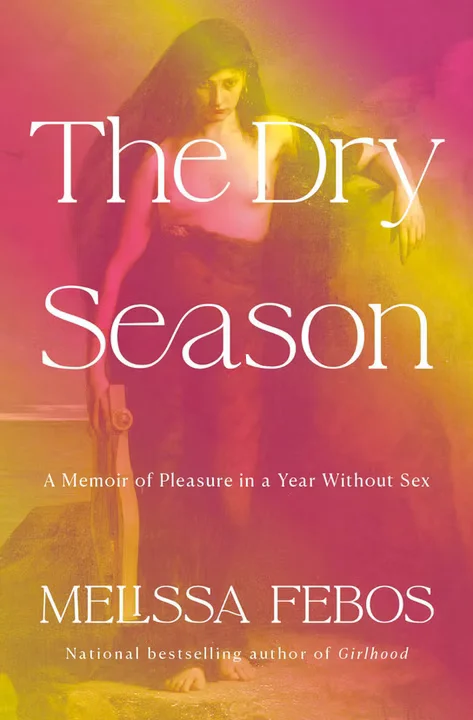
The Dry Season
Date read: 2026-10-26
ISBN: 9780593537237
Link to buy the bookMy notes
Each had a frantic tinge, like the last handful of popcorn you cram into your mouth after you decide to stop eating it.
I texted her while I ran on the treadmill at the gym, while my students wrote in class, at red stoplights on the drive home, and while I brushed my teeth, spattering my sleep T-shirt with toothpaste as I smiled at my phone like a baby.
The problem with making a radical personal decision is that it pales in comparison to most things one might consider radical, like political revolution, religious conversion, suicide, or even divorce.
Anxiety, one therapist told me, is a secondary emotion, a response to emotion. Buddhists calls this the second arrow. I don’t know what Catholics call it, probably guilt.
I knew that I was probably using the dopamine of a new infatuation to anesthetize the pain of my breakup, but reasoned that after such a hard two years I deserved a little fun.
In my recovery community, people often say that one’s bottom gets lower the longer one is sober. That is, the deeper we get into recovery, the clearer we can see the wreckage of the past.
A cigarette provides both hunger and satisfaction, organizes a day into a series of resolved plots: the rising desire and its perfect fulfillment. It offers a trail of breadcrumbs to follow through the chaos of life and its many unmet desires, its less predictable pleasures
“despite ideals and philosophy, you find yourself a player in a process that bears unquestionable similarity to a game. The prize is not trifling; reciprocation produces ecstasy.”
the text has the gorgeous moral certainty of a twenty-five-year-old, which is hard to sustain as one ages
“In reaching out in physical love, there is still the desire to mold the other person’s energy under the guise of togetherness.”
“They are not free. They are too bound by their own need to own another.”
Having nothing left to gain could be a vulnerable position, though not one for which I had much curiosity, or sympathy.
Hoarding is a symptom of fear, the fear of scarcity. When a comfort is fleeting, as that of romance was for me, it made sense to stockpile it.
If my ceaseless entanglements were a result of the ways that I related to other people, then the goal of my celibacy was to relate to myself.
The woman asked questions formulated to draw me out but did not absorb my answers, which beaded like rain on her glassy exterior.
When I stripped away the great swells of feeling that obscured it, I could see how those habitually compelled by this ecstasy were almost robotic in their pursuit, like sex Roombas.
Like Kelli María Korducki, I had “long suspected that women subconsciously accept some version of the belief that we’re supposed to want secure romantic relationships more than anything in the world.”
but because I had named something that felt so private, understood it with such little information that it suggested an ordinariness to what felt exceptional.
The writer of a memoir is both the director and a character in her play, and thus enjoys refuge outside of its narrative. An author is the god of their story and must sustain the long view, the cool curatorial eye. I wanted my art to be beautiful, even when it described something ugly.
spiritual ecstasy, which is primarily the ecstasy of self-forgetting, a total engrossment and devotion to something other than the self
There is no corner left for seeing I in the mesmeric hypnosis of a toxic relationship, either.
It is so much easier to control a person with enormous appetites.
“As long as she thinks of a man,” wrote Virginia Woolf, “nobody objects to a woman thinking.”
Liberation of the mind was essential to the liberation of one’s art. I supposed my growing awareness of the television’s myopic offerings and the attendant frustration were signs of my liberating mind, but I had hoped that liberation would feel, well, more liberating. Sometimes, it felt merely annoying.
As Nicky Hayes writes of extended limerences: “it is the unobtainable nature of the goal which makes the feeling so powerful.”
Aversion to embarrassment makes it incredibly hard to be vulnerable, and avoidance of vulnerability robs us of true connection with other people, the deep comforts of being known and receiving love.
We are taught that obsession is romantic, but at its far reaches it is not. It is hell.
Even as a sensitive and eager-to-please child I understood that there was an amoral aspect of me, a potential that if triggered by the right circumstances would render me without limits, capable of anything.
The mother character is awful, but I recognized the appeal of such data-keeping, the comfort of a finite numerical record of a cycle over which one is powerless. The small taste of control it gives. The old fantasy that to recognize is to master.
This was the flipside of seduction in all arenas, as a woman: the potential for humiliation was ever present. What a thorny conundrum, to want to be wanted and hate being humiliated.
Hadn’t I always just wanted to be pretty? A little thinner? Didn’t everyone want to be wanted? No, I had craved safety. Freedom from a vigilance that exhausted me.
“A lot of people will think that social understanding or something like that is going to lead us to the truth, but it isn’t. It is understanding of yourself.”
How stupid I had been to think that the urge to please precluded harm. It was an urge driven by fear, not magnanimity. Self-centered fear leaves no room to care for another.
The beauty of the inventory was that its aim was to locate not blame but my own responsibility, to let those stories settle in the in-between space where all love ultimately lay: the field on which every person did their best, whatever the wreckage.
It also offered a kind of permission, whispered across centuries on the pages of books and the crooning lips of entertainers, to those whose nature inclined toward obsession. Go for it, whispered seven centuries of love literature.
Obsession made us stupid. Once that drive ignited, reason became a stranger. There was only hunger and new ways to chase it.
The difference between bondage to a single necessity and the perfect freedom of one was agency.
“It’s exhilarating to be alive in a time of awakening consciousness;” writes Adrienne Rich. “It can also be confusing, disorienting, and painful.”
My favorite described the Jewish practice of repentance, which unfolds in three parts: a change of heart, a decision to change, and the act of confession.
I have written every poem, every novel, for the same reason—to find out what I think, to know where I stand
It was disorienting to visit her and have nothing else to do, no one to call and wish good night, no higher priority than to be with my friend. It was rich as custard, deep and satisfying in the way of a good poem or a hard afternoon nap, of which I took several during my visit.
and I are the same breed of cat, responsive and sensitive close to the surface. Willing to give ourselves away. Such people rarely lead happy lives, but they do lead lives of constant growth and change. Gerald Heard’s saying ‘he must go unprotected that he may be constantly changed’ always comes to mind
“For masterpieces are not single and solitary births; they are the outcome of many years of thinking in common, of thinking by the body of the people, so that the experience of the mass is behind the single voice.”
Identity is a story other people tell us, that we learn to tell ourselves, that is housed inside relationships. It is a comfort to be known, to be anchored by these touchstones, and they can limit us.
“The power of a free mind consists of trusting your own mind to ask the questions that need to be asked and your own capacity to figure out the strategies you need to get those questions answered,”
“People are just people,” my mother went on. “Every relationship is work and I can’t pretend that it won’t be anymore. I’m happy with the person and the work I’ve chosen.”