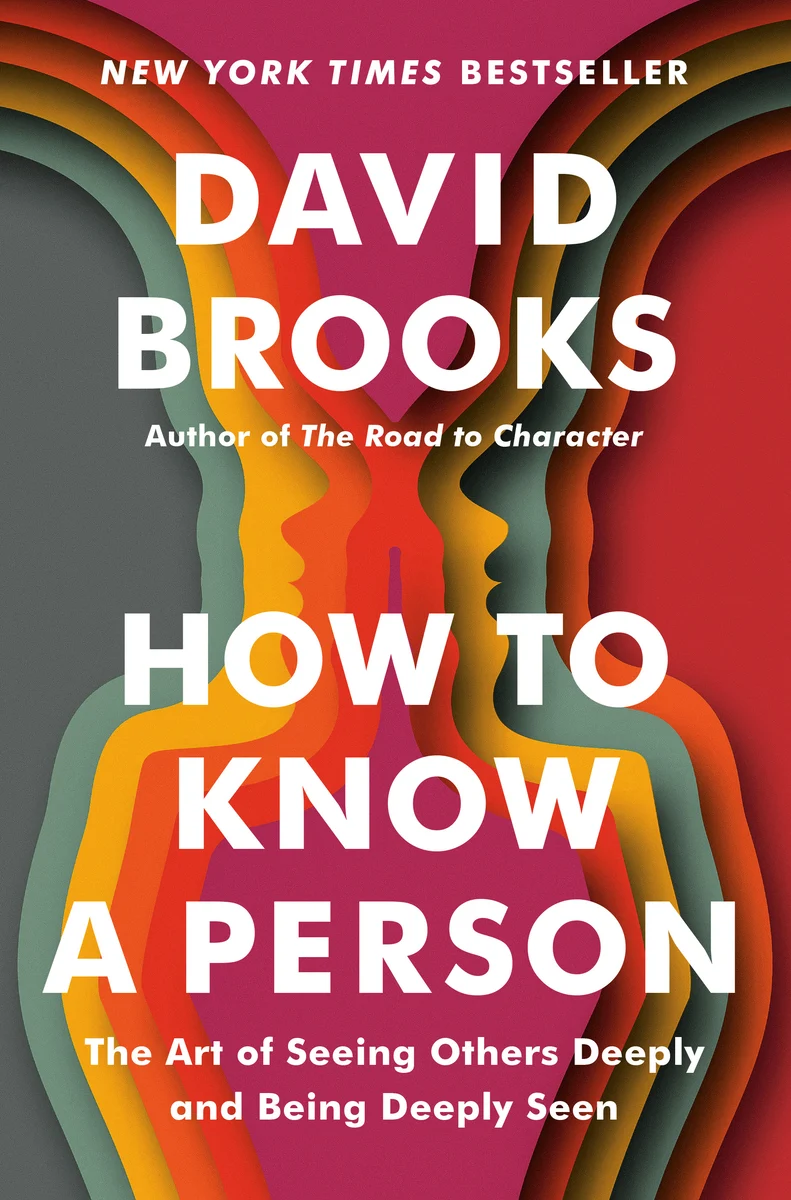
How to Know a Person
Date read: 2025-12-26
ISBN: 9780593230077
Link to buy the bookA journalist's approach to creating safe spaces for people to tell their story. He delves into the psychology of identity creation and the path to wisdom, which I found really interesting.
My notes
“Experience is not what happens to you, it’s what you do with what happens to you.”
“We do not see things as they are, we see things as we are.”
“Life isn’t about finding yourself. Life is about creating yourself.”
The politics trap: to be moral in this world, you don’t have to feed the hungry or sit with the widow. You just have to be liberal or conservative, you just have to feel properly enraged at the people you find contemptible.
Remember that the person who is lower in any power structure than you are has a greater awareness of the situation than you do. A servant knows more about his master than the master knows about the servant.
The authors of Crucial Conversations observe that in any conversation, respect is like air. When it’s present nobody notices, but when it’s absent it’s all anybody can think about.
“I write,” Susan Sontag once remarked, “to define myself—an act of self-creation—part of the process of becoming.”
The essential moral act in this model of character formation is self-mastery. It is exercising willpower so that you are the master of your passions and not their slave.
Punishing children so they won’t repeat bad behavior doesn’t work, she argues. Focusing on the “positive opposite” does. Instead of calling attention to the behavior you want your child to stop, call attention to the behavior you want them to do.
To establish a sense of agency, people develop what Kegan calls an imperial consciousness. People with this mindset can be quite self-centered. Their own desires and interests are paramount. The world is a message about me, about how I am valued.
A person embedded in this task, and the imperial consciousness that emerges to help people complete it, probably doesn’t have a rich internal life. He’s not going for self-knowledge; he’s trying to make his presence impressive to the world.
People in the midst of the interpersonal task often become idealistic. The person with an interpersonal consciousness can not only experience other people’s experiences, she can experience the experience of humanity as a whole.
The interpersonal person’s ultimate question is: Do you like me? At this point, her own self-appraisal is not yet the arbiter of her sense of self-worth. The opinions of others are still the ultimate arbiters.
During the generative life task, people try to find some way to be of service to the world. One either achieves generativity, Erikson argues, or one falls into stagnation. Vaillant defines generativity as “the capacity to foster and guide the next generations.”
They adopt a gift logic—how can I give back to the world—that replaces the meritocratic logic of the career consolidation years.
A generative leader serves the people under him, lifts other people’s vision to higher sights, and helps other people become better versions of themselves.
A person with this mindset is defined not by what she takes out of the institution but by what she pours into it.
The needs of the world are so many, they often told me. I can’t let people down. In my experience, selfless people are as prone to burnout as selfish ones—maybe more so.
Integrity is the ability to come to terms with your life in the face of death. It’s a feeling of peace that you have used and are using your time well.
The psychoanalyst Philip M. Bromberg wrote, “Health is the ability to stand in the spaces between realities without losing any of them. This is what I believe self-acceptance means and what creativity is really all about—the capacity to feel like one self while being many.”
The psychologist Laura Carstensen finds that as people get older, emotion often takes the place of rational thinking. People feel free to cry more, are more adept at pulling differentiated emotions into consciousness. The awareness of death tends to make life’s trivialities seem…trivial.
My hope is that this focus on life tasks can help remind that each person you meet is at one spot on their lifelong process of growth.
“All growth is costly,” Kegan writes. “It involves leaving behind an old way of being in the world.”
We don’t start conversations because we’re bad at predicting how much we’ll enjoy them. We underestimate how much others want to talk; we underestimate how much we will learn; we underestimate how quickly other people will want to go deep and get personal.
’m no longer content to ask, “What do you think about X?” Instead, I ask, “How did you come to believe X?” This is a framing that invites people to tell a story about what events led them to think the way they do
Similarly, I don’t ask people to tell me about their values; I say, “Tell me about the person who shaped your values most.” That prompts a story.
You can’t know who you are unless you know how to tell your story. You can’t have a stable identity unless you take the inchoate events of your life and give your life meaning by turning the events into a coherent story.
Some people use their own name when talking to themselves. By the way, the people who address themselves in the second or even the third person have less anxiety, give better speeches, complete tasks more efficiently, and communicate more effectively. If you’re able to self-distance in this way, you should.
So when I’m listening to someone tell their story, I’m also asking myself, What characters does this person have in his head? Is this a confident voice or a tired voice, a regretful voice or an anticipating voice?
our late twenties or early thirties, most of us have what McAdams calls an imago, an archetype or idealized image of oneself that captures the role that person hopes to play in society
The psychologist James Marcia argues that there are four levels of identity creation. The healthiest people have arrived at what he calls “identity achievement.” They’ve explored different identities, told different stories about themselves, and finally settled on a heroic identity that works.
The third thing I’m asking myself as people tell me their stories is: What’s the plot here? We tend to craft our life stories gradually, over a lifetime.
Some people, for example, see their lives as “Overcoming the Monster,” in which the hero defeats some central threat, like alcoholism, through friendship and courage. Other people view their lives as “Rags to Riches,” in which the hero starts out impoverished and obscure and rises to prominence. Or they see their lives as a “Quest,” a story in which the hero undertakes a voyage in pursuit of some goal and is transformed by the journey.
Many Americans, McAdams has found, tell redemption stories. That is to say, they see their lives within a plotline in which bad things happened, but they emerged from them stronger and wiser.
m always intrigued by people who see their lives as a surfing story: I caught a wave and rode it, then I caught another wave. Then another. That’s a relaxed acceptance of life few of us can muster.
The next question I ask myself when hearing stories is: How reliable is this narrator? I guess all of our stories are false and self-flattering to some degree.
“We are so used to disguising ourselves from others that we often end up by disguising ourselves from ourselves.”
Frequently the goal of therapy is to help the patient tell a more accurate story, a story in which the patient is seen to have power over their own life. They craft a new story in which they can see themselves exercising control.
When we go back and tell our life story with honesty and compassion, the theologian H. Richard Niebuhr wrote, “we understand what we remember, remember what we forgot, and make familiar what had before seemed alien.”
But if you stand more transparently before me, showing both your warts and your gifts, you feel my respectful and friendly gaze upon you, and that brings forth growth. In every life there is a pattern, a story line running through it all. We find that story when somebody gives an opportunity to tell it.
When I’m looking at you, and trying to know you, I’m going to want to ask you how your ancestors show up in your life. And if you are looking at me, you’ll want to ask how the past lives in me.
We’ve come to believe that wise people don’t tell us what to do; they start by witnessing our story. They take the anecdotes, rationalizations, and episodes we tell, and see us in a noble struggle.
Wise people don’t tell you what to do; they help you process your own thoughts and emotions. They enter with you into your process of meaning-making and then help you expand it, push it along.
Wise people create a safe space where you can navigate the ambiguities and contradictions we all wrestle with. They prod and lure you along until your own obvious solution emerges into view.
She is creating an atmosphere in which people swap stories, trade confidences. In this atmosphere people are free to be themselves, encouraged to be honest with themselves.
Out of your own moments of suffering, struggle, friendship, intimacy, and joy comes a compassionate awareness of how other people feel—their frailty, their confusion, and their courage. The wise are those who have lived full, varied lives, and reflected deeply on what they’ve been through.
Critiquing with care works best when someone names something we ourselves almost but did not quite know. Critiquing with care works best when that naming happens within a context of unconditional regard, that just and loving attention that conveys unshakable respect for another person’s struggles.
“If equal affection cannot be / Let the more loving one be me.”