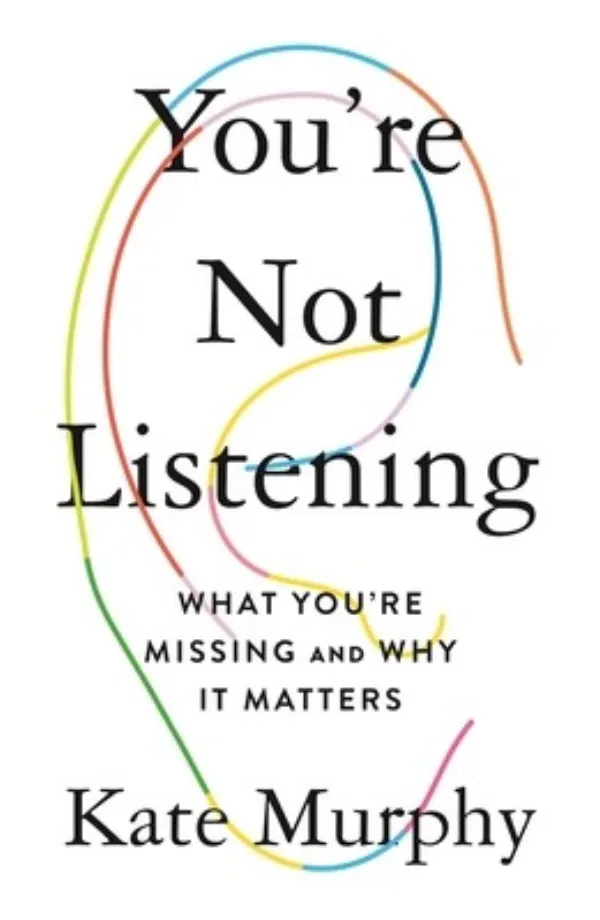
You're Not Listening
Date read: 2026-05-22
ISBN: 9781473561106
Link to buy the bookMy notes
Attentive and responsive caregivers set you up to have a secure attachment style, which is characterized by an ability to listen empathetically and thus, form functional, meaningful, and mutually supportive relationships.
To listen well is to figure out what’s on someone’s mind and demonstrate that you care enough to want to know.
The most valuable lesson I’ve learned as a journalist is that everybody is interesting if you ask the right questions.
When people say things such as, “Speaking as a white man,” or “Speaking as a woman of color,” that’s impossible. One can only speak for one’s self.
There is an inverse relationship between signaling and listening.
The world is easier to navigate if you remember that people are governed by emotions, acting more often out of jealousy, pride, shame, desire, fear, or vanity than dispassionate logic.
He said listening well is a matter of continually asking yourself if people’s messages are valid and what their motivations are for telling you whatever they are telling you.
While we fear silences almost as much as saying the wrong thing (more about that later), a pause following someone’s comments can actually work to your advantage, as it’s a sign of attentiveness.
self-psychology holds that repaired rifts are the fabric of relationships rather than patches on them. Indeed, if you think about the people whom you trust and feel closest to in your life, they are undoubtedly the ones who have come back after a flub and made it right.
“Why?” tends to make people defensive—like they have to justify themselves. Instead, Naomi turned her question into an invitation: “Tell me about the last time you went to the store after 11:00 p.m.”
Data sets shed light only on what’s in the data set.
Intimacy, innovative thinking, teamwork, and humor all come to those who free themselves from the need to control the narrative and have the patience and confidence to follow the story wherever it leads.
Controlling the narrative and grabbing for attention make for one-sided conversations and kill collaboration.
The joy and benefit of human interactions come from a reciprocal focusing on one another’s words and actions, and being ready and willing to respond and expand on every contribution.
“You have to listen to them long enough to be able to repeat back something they said and put a funny twist on it and also to know what the lines are that you’d better not cross,”
Misunderstandings, then, can be seen as an opportunity. They are an inspiration, or perhaps an aggravation, to listen more closely and inquire more deeply. In the words of Miles Davis, “If you understood everything I said, you’d be me.”
Where they were, what time, what they ordered—none of it matters as much as what happened and how it felt.
Good questions don’t begin with: “Don’t you think…?” “Isn’t it true…?” “Wouldn’t you agree…?” And good questions definitely don’t end with “right?” These are actually camouflaged shift responses and will likely lead others to give incomplete or less-than-honest answers that fit the questioner’s opinions and expectations.
“What made you decide to become a sociologist?” Becker’s face contorted as if he’d just smelled something dreadful. “You’re assuming it was a decision,” he said. “Better to ask, ‘How did it happen that you became a sociologist?’”
Being aware of someone’s troubles does not mean you need to fix them. People usually aren’t looking for solutions from you anyway; they just want a sounding board.
Your answer to someone else’s deepest difficulties merely reflects what you would do if you were that person, which you are not.
It’s hard to ask open and honest questions because most people ask questions that are really recommendations or judgments in disguise.
Similar to the “The 36 Questions That Lead to Love” mentioned earlier, the conversation starters are curious rather than appraising, seeking to find out not what someone has achieved but who the person really is.
Research shows that being able to comfortably sit in silence is actually a sign of a secure relationship. Higher-status people also aren’t as likely to get agitated by gaps in conversation, presumably because they are more secure in their position.
To be a good listener is to accept pauses and silences because filling them too soon, much less preemptively, prevents the speaker from communicating what they are perhaps struggling to say.
As a journalist, it took me too long to realize that I didn’t have to say anything to keep the conversation going. Some of the most interesting and valuable bits of information have come not from my questioning but from keeping my mouth shut. You get so much more out of interactions when you allow people the time and space to gather their thoughts.
If a full day seems daunting, try staying silent during a single conversation. Don’t say anything unless asked a question. See what happens.
Listening to the “other” is what reminds us of our common human vulnerability and fragility, and it imposes the ethical imperative, or duty, to do no harm.
But as both partners prove their trustworthiness by their attentiveness, sensitivity, and discretion, their relationship deepens, which leads them to engage in more significant transactions (i.e., disclosing more tightly held information).
“guided only by the lantern of his own understanding, the individual loses all assurance of a place, an order, a definition. He may have gained freedom, but he has lost security.”
“Everyone must sell himself as a person, in order to be accepted,” Bruckner writes. But this constant self-promotion and image cultivation comes at a cost. We lose touch with others and ultimately our sense of belonging and connection, which was all we really wanted in the first place.
While you may feel a sense of urgency to tell people how you feel, it’s not always helpful. You are putting your ego ahead of the other person’s vulnerability. This doesn’t mean you have to be dishonest or self-effacing, but you do need to listen enough to know when the other person is ready to hear what you have to say.
People tend to regret not listening more than listening and tend to regret things they said more than things they didn’t say.
Not listening is ripe for regret because once you let the opportunity slip away, you can never re-create the moment and often don’t realize what you missed until it’s too late.
The best communicators, whether addressing a crowd or a single individual, are people who have listened, and listened well, in the past and continue to listen in the moment. They are able to engage, entertain, and inspire because they first try to get a sense of their audience and then choose their material and style of delivery accordingly.
Conversation, at its best, is a continual listening feedback loop that shapes what people say and how they say it.
Careful listening is draining, regardless of your personality, aptitude, or motivation.
But not listening because you don’t have the intellectual or emotional energy to listen at that moment makes you human.
“In our business, there are some patients you can’t treat. But also in life, there are some stories you just can’t hear. Every person has to know that. That’s the limit of human experience, and that’s okay.”
A good listener takes the time and makes the effort to help people find their voice, and in so doing, intimacy and understanding are earned.
By listening, you acknowledge and embrace the world that is going on outside your head, which helps you sort out what’s going on inside your head.
And also know that people change, and your view of them changes, when you truly listen. It often pays to first make the effort before you decide to pull the plug.
Whether someone is confessing a misdeed, proposing an idea, sharing a dream, revealing an anxiety, or recalling a significant event—that person is giving up a piece of him or herself. And if you don’t handle it with care, the person will start to edit future conversations with you, knowing, “I can’t be real with this person.”
As you become more attuned to the thoughts and emotions of others, you become more alive to the world and it becomes more alive to you. Life otherwise can become a muted existence, with days spent cocooned in unquestioned beliefs and fixed concepts, where, even though the world and the people in it are always changing, nothing is ventured beyond the borders of what you already know or accept as true.
The Swiss psychologist Jean Piaget talked about the collective monologue of preschoolers. Put several of them together and they jabber away to themselves rather than to one another.
It’s impossible to convince someone that you respect them by telling them so. It must be demonstrated, and listening is the simplest way to do that.
We also fear that if we listen too carefully, we might discover that our thinking is flawed or that another person’s emotions might be too much to bear. And so we retreat into our own heads, talk over one another, or reach for our phones.
A listener has a reactive effect on the speaker. As a result, careful listening elevates the conversation because speakers become more responsible and aware of what they are saying.
To be a good listener does not mean you must suffer fools gladly, or indefinitely, but rather helps you more easily identify fools and makes you wise to their foolishness.
While people often say, “I can’t talk right now,” what they really mean is “I can’t listen right now.”