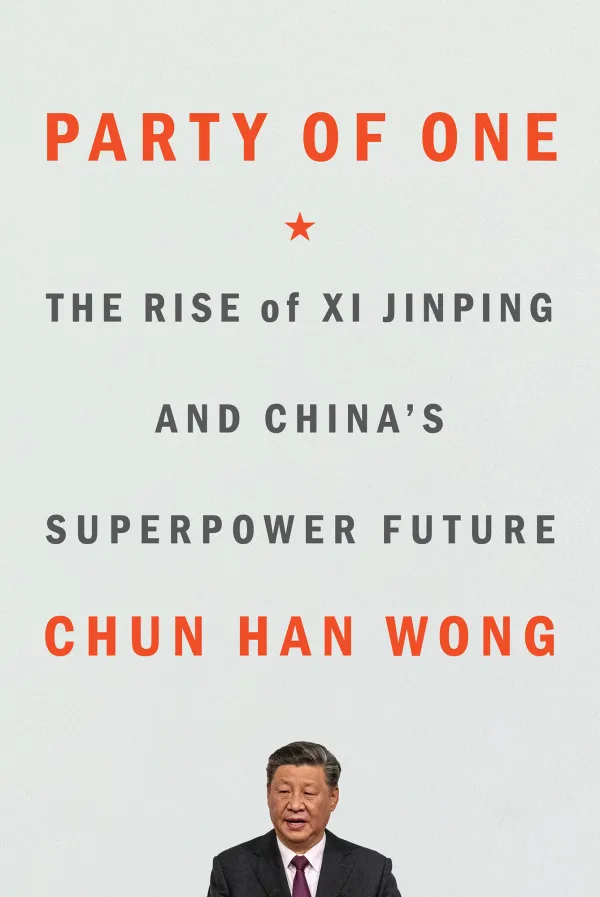
Party of One
Date read: 2026-07-24
ISBN: 9781982185756
Link to buy the bookMy notes
“Mao Zedong let the Chinese people stand up, Deng Xiaoping let the Chinese people get rich, Xi Jinping will let the Chinese people get strong.”
“Xi Jinping talked at length about how China’s natural state is entropy, that there are forces of division and separatism within the country and also external forces trying to break it apart,”
An investigation against a big-name target was almost certainly party infighting waged under the cover of combating corruption—a convenient fig leaf that departed from how Mao-era officials purged rivals by accusing them of political deviancy.
While state media played up Xi’s tiger-slaying, he avoided wholesale attacks on China’s “red bloodlines,” the revolutionary families enmeshed in lucrative sectors of state industry and private business.
Whereas his predecessors often delegated the finer details of policy-making to specialists, a practice known as “grasping the large, releasing the small,” Xi prefers a hands-on approach. He often makes direct requests for policy adjustments and insists that he gets the final call on key decisions.
The party in China has long relied on what political scientists call “campaign-style governance,” whereby Beijing mobilizes large volumes of personnel and resources to achieve specific goals within a certain time frame.
Many legal scholars argue that China practices “rule by law,” whereby the powers that be use legislation as tools of control and impose few constraints on their own authority, as opposed to the “rule of law,” where the rulers and the ruled are both treated equally under the same legal standards.
Rather than the “rule of law,” the party came to operate by what the late political scientist Mayling Birney called the “rule of mandates,” whereby front-line cadres were largely free to bend, ignore, or even break the law as they pursued directives—or “mandates”—assigned by their superiors.
Jude Blanchette, a China analyst at the Washington-based Center for Strategic and International Studies, dubbed this new model “CCP Inc.”—a broad ecosystem comprising state, private, and hybrid-ownership companies that operate across entire value chains, tap international capital markets, and align with the party’s industrial strategies.
What makes entrepreneurs especially vulnerable to such tactics is that China’s private sector has long been clouded by the notion of “original sin,” or the suspicion that many businesses acquired assets and established themselves through illicit means.
The “century of humiliation” forms the spine of the People’s Republic’s founding mythology, where the party emerged as China’s rightful rulers by avenging its indignities and restoring its honor. This narrative is Xi’s most valued inheritance, handed down since Mao to successive leaders who tapped its evocative power to justify the party’s legitimacy—and their own.
The future is invariably utopian, the past contested ground.
The efforts to palliate Mao’s legacy help Xi justify his autocratic style and legitimize Communist rule for the long term.