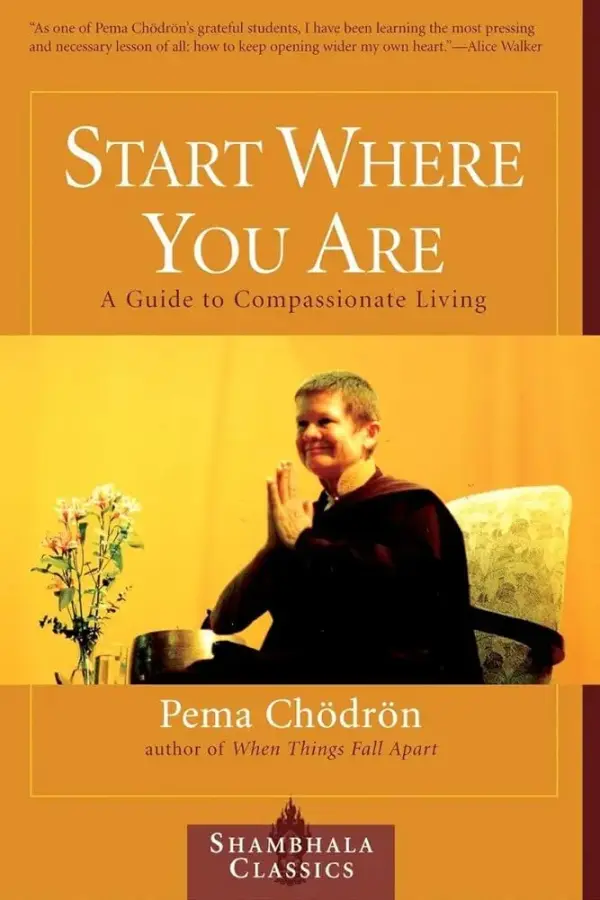
Start Where You Are
Date read: 2025-12-15
ISBN: 9781570628399
Link to buy the bookMy notes
There are whole parts of ourselves that are so unwanted that whenever they begin to come up we run away. Because we escape, we keep missing being right here, being right on the dot. We keep missing the moment we’re in.
Be generous with your insights and delights. Instead of fearing that they’re going to slip away and holding on to them, share them.
The Tibetan word for pride or arrogance, which is nga-gyal, is literally in English “me-victorious.” Me first. Ego. That kind of “me-victorious” attitude is the cause of all suffering.
We go for anything—seven pairs of boots that fit inside each other so we don’t have to feel the ground, twelve masks so that no one can see our real face, nineteen sets of armor so that nothing can touch our skin, let alone our heart.
Realizing our wealth would end our bewilderment and confusion. But the only way to do that is to let things fall apart.
Yet letting things fall apart would actually let fresh air into this old, stale basement of a heart that we’ve got.
We’re always not wanting to be who we are. However, we can never connect with our fundamental wealth as long as we are buying into this advertisement hype that we have to be someone else, that we have to smell different or have to look different.
We went for a walk this morning, but now it is a memory. Every situation is a passing memory.
The absolute quality of bodhichitta can never be pinned down. If you can talk about it, that’s not it. So if you think that awakened heart is something, it isn’t. It’s passing memory.
This moving away from comfort and security, this stepping out into what is unknown, uncharted, and shaky—that’s called enlightenment, liberation.
You can pull out your own rug, and you can also let life pull it out for you.
“Self-liberate even the antidote,”
These thoughts that come up, they’re not bad. Anyway, meditation isn’t about getting rid of thoughts—you’ll think forever.
So if you think that everything is solid, that’s one trap, and if you change that for a different belief system, that’s another trap.
“Good and bad, happy and sad, all thoughts vanish into emptiness like the imprint of a bird in the sky.”
At the everyday kitchen-sink level, it simply means that as you see things in yourself that you think are terrible and not worthy, maybe you could reflect that that’s Buddha.
We generally interpret the world so heavily in terms of good and bad, happy and sad, nice and not nice that the world doesn’t get a chance to speak for itself. When we say, “Be a child of illusion,” we’re beginning
Write less; don’t try to capture it all on paper. Sometimes writing, instead of being a fresh take, is like trying to catch something and nail it down.
When we are not trying to capture anything we become like a child of illusion.
“Well, my life has taught me to be more curious than afraid.”
You just keep speaking to yourself, so nothing speaks to you.
The moral of the story is, when the resistance is gone, so are the demons.
You can bring all of your unfinished karmic business right into the practice. In fact, you should invite it in.
The technique is that you do not blame Mortimer; you also do not blame yourself. Instead, there is just liberated fury—hot, black, and heavy. Experience it as fully as you can.
You cannot fake these things; therefore you start with the things that are close to your heart.
It’s all opportunity for practice. There is no interruption.
People harm each other—we harm others and others harm us. To know that is clear seeing.
“How can I communicate? How can I help the harm that has been done unravel itself? How can I help others find their own wisdom, kindness, and sense of humor?”
Whether we’re talking about the painful international situation or our painful domestic situation, the pain is a result of what’s called ego clinging, of wanting things to work out on our own terms, of wanting “me-victorious.”
To be fearless isn’t really to overcome fear, it’s to come to know its nature. Just open the door more and more and at some point you’ll feel capable of inviting all sentient beings as your guests.
We will fall flat on our faces again and again, we will continue to feel inadequate, and we can use these experiences to wake up, just as they did.
What’s actually under all that talking and conversation about how wrong somebody or something is? What does blame feel like in your stomach?
When these really unresolved issues of our lives come up, we are no longer trying to escape but are beginning to be curious and open toward these parts of ourselves.
If you aren’t feeding the fire of anger or the fire of craving by talking to yourself, then the fire doesn’t have anything to feed on.
“Drive all blames into one” is saying, instead of always blaming the other, own the feeling of blame, own the anger, own the loneliness, and make friends with it.
“Be grateful to everyone” means that all situations teach you, and often it’s the tough ones that teach you best.
He said that setting goals for others can be aggressive—really wanting a success story for ourselves. When we do this to others, we are asking them to live up to our ideals. Instead, we should just be kind.
Something between repressing and acting out is what’s called for, but it is unique and different each time. People have the wisdom to find
Compassionate action, compassionate speech, is not a one-shot deal; it’s a lifetime journey.
Everything in our lives can wake us up or put us to sleep, and basically it’s up to us to let it wake us up.
Resistance to unwanted circumstances has the power to keep those circumstances alive and well for a very long time.
“If it’s better for me to be sick, so be it. If it’s better for me to recover, so be it. If it’s better for me to die, so be it.”
Regret implies that you’re tired of armoring yourself, tired of eating poison, tired of yelling at someone each time you feel threatened, tired of talking to yourself for hours each time you don’t like the way someone else does something, tired of this constant complaint to yourself.
The initial bite, or the initial drink, or the initial harsh word might give you some feeling of well-being, but it’s followed by the chain reaction of misery that you’ve been through not once but five thousand times.
You can refrain from doing it again because you don’t want to harm yourself anymore. You can practice because you have basic respect for yourself, and you wish to do what nurtures your sense of confidence and warriorship rather than what makes you feel more poverty-stricken and isolated.
The point is that the happiness we seek is already here and it will be found through relaxation and letting go rather than through struggle.
In fact, that’s the way to live: stop struggling against the fact that things are slipping through our fingers.
“Just be willing to die over and over again.”
It’s all in the “pleasantness of the presentness,” in the very discursive thoughts you’re having now, in all the emotions that are coursing through you; it’s all in there somehow.
Reproach doesn’t have to be a negative reaction to your personal brand of insanity. But it does imply that you see insanity as insanity, neurosis as neurosis, spinning off as spinning off.
“Pema, what do you really want? Do you want to shut down and close off, do you want to stay imprisoned? Or do you want to let yourself relax here, let yourself die? Here’s your chance to actually realize something. Here’s your chance not to be stuck. So what do you really want? Do you want always to be right or do you want to wake up?”
It doesn’t matter that you can’t do it every time. Just the willingness, the strong determination to do it, is sowing the seeds of virtue.
Buddhism itself is all about empowering yourself, not about getting what you want.
if the way that we protect ourselves is strong, then suffering is really strong too.
The messy stuff that we see in ourselves and that we perceive in the world as violence and cruelty and fear is not the result of some basic badness but of the fact that we have such a tender, vulnerable, warm heart of bodhichitta, which we instinctively protect so that nothing will touch it.
We’re simply saying that the way to change the pattern is to begin to breathe in and connect with the heart, the soft spot that’s under all that protecting.
The idea of karma is that you continually get the teachings that you need in order to open your heart.
You could see your life as an adult education course.
When things are going well, that can also be a reminder Instead of habitually clinging to what’s delightful, you could become accustomed to giving it away, sending it out to others on the outbreath.
“Always maintain only a joyful mind” can be very helpful to remember in such a situation.
However, all these words are saying the same thing: we practice and we live in order to be able to relax and lighten up and not make such a big deal about everything that happens—the successes and the failures, the rewards and the punishments.
One of the things that keeps us unhappy is this continual searching for pleasure or security, searching for a little more comfortable situation, either at the domestic level or at the spiritual level or at the level of mental peace.
If you’re going to be a grown-up—which I would define as being completely at home in your world no matter how difficult the situation—it’s because you will allow something that’s already in you to be nurtured.
anything that you can experience or think is worthy of compassion; anything you could think or feel is worthy of appreciation.
If one would enter into an unconditional relationship with oneself, one would be entering into an unconditional relationship with buddha.
There’s nothing that you can think or feel that gets put in the category of “wrong.” It’s all good juicy stuff—the manure of waking up, the manure of achieving enlightenment, the art of living in the present moment.
Having understood the futility and pain of always holding on to yourself, you want to take the next step and begin to work with others.
Let righteous indignation be your guide that someone is holding on to themselves, and that someone is probably you.